
Can Botox Fix An Asymmetrical Face? Which Imbalances Respond And Which Do Not
Written and medically reviewed by Dr. Ashutosh Shah, plastic surgeon, [CREDENTIALS]. Reg. no. [REGISTRATION NO.]. Published 7 October 2026. Last reviewed 7 October 2026.
Botox can fix an asymmetrical face when the imbalance comes from one muscle pulling harder than its partner, such as a higher eyebrow, a lopsided smile or one bulkier jaw muscle. It cannot correct uneven bone, fat or skin. Those need filler or surgery, so the first step is finding out which layer is causing the difference.
Most people asking "can Botox fix asymmetrical face" already know one side looks different in photos. The useful question is why it looks different, because the cause decides whether a few units of Botox will help or do nothing at all. This guide explains how to tell the difference.
What causes a face to look uneven?
A face looks uneven when one of four layers differs between the sides: muscle, bone, fat or skin. Nobody has a perfectly symmetrical face, so small differences are normal. Treatment is only worth considering when a difference bothers you or affects function.
- Muscle: one muscle is stronger or more active, often from habit, such as chewing on one side or raising one eyebrow.
- Nerve: after Bell's palsy or nerve injury, one side is weak and the healthy side over-pulls.
- Bone: differences in jaw, chin or cheekbone growth, sometimes linked to the bite or teeth.
- Fat and volume: uneven fat loss, often from sleeping on one side, weight change or rare conditions.
- Skin: scars, sun damage and sagging that differ between sides.
Which muscle-driven asymmetries can Botox balance?
Botox can balance asymmetries caused by one muscle being stronger than its partner on the other side. It works by relaxing the stronger muscle, so the two sides pull more evenly.
- One eyebrow higher than the other: relaxing the forehead muscle on the higher side lets it settle, or relaxing the muscle that pulls the lower brow down lets it lift slightly. Our page on Botox for a sagging brow explains the lift technique.
- Uneven smile: uneven smile Botox usually targets a muscle that pulls one mouth corner down, or a lip lifter that raises one side higher when smiling.
- One bulkier jaw: a thicker masseter (chewing muscle) on one side can be slimmed over a few months. See Botox for a square jaw.
- Uneven chin dimpling, neck bands or crow's feet: each can be relaxed more on the stronger side.
Can Botox make my smile even?
Often, yes, if the unevenness appears mainly when you smile. Smile muscles are small and close together, so doses are low and placement is precise. Too much can make the smile look flat, which is why we start conservatively.
Is Botox used for face asymmetry after facial palsy?
Yes. Botox for facial palsy asymmetry is a recognised part of palsy care, used in two different ways:
- When the palsy side stays weak, Botox goes into the healthy side, which over-pulls and makes the face look twisted. Relaxing it brings both sides closer together.
- When the palsy side has recovered with synkinesis (unwanted linked movements, such as the eye closing when you smile), Botox goes into the affected side to calm those movements.
A 2024 review of Botox after facial palsy describes both uses but notes there are no standardised dosing recommendations, so treatment is planned case by case. An earlier hospital series on the healthy-side technique showed the same balancing effect around the mouth.
Which asymmetries need filler, fat or surgery instead?
Asymmetries caused by bone, volume or skin need filler, fat grafting or surgery, because Botox only relaxes muscle. If the difference is still clearly visible when your face is completely still, Botox is unlikely to fix it.
| Feature | Likely cause | Does Botox help? | Better option if not |
|---|---|---|---|
| One eyebrow higher, mainly when talking or raising brows | Muscle | Yes | Not needed |
| Smile pulls higher or lower on one side | Muscle | Yes, in most cases | Filler at the mouth corner if volume is also low |
| One jaw wider, firm when clenching | Muscle (masseter) | Yes | Not needed |
| One jaw wider, not firm when clenching | Bone | No | Filler camouflage on the smaller side, or jaw surgery |
| Chin or jaw shifted to one side | Bone or bite | No | Orthodontic or jaw surgery assessment, filler camouflage |
| One cheek flatter or hollower | Fat or volume | No | Filler or fat grafting |
| One side sagging or more lined at rest | Skin | Little | Skin treatments or lifting surgery |
| One eyelid lower than the other | Eyelid muscle weakness (ptosis) | No, it can worsen it | Eyelid assessment and ptosis surgery |
| Palsy side with no movement | Nerve | Only on the healthy side | Facial reanimation surgery |
For volume and bone camouflage without an operation, see our guide on Non-surgical facial contour correction. That is the main face asymmetry treatment without surgery when Botox is not the answer.
How is asymmetry measured before treatment?
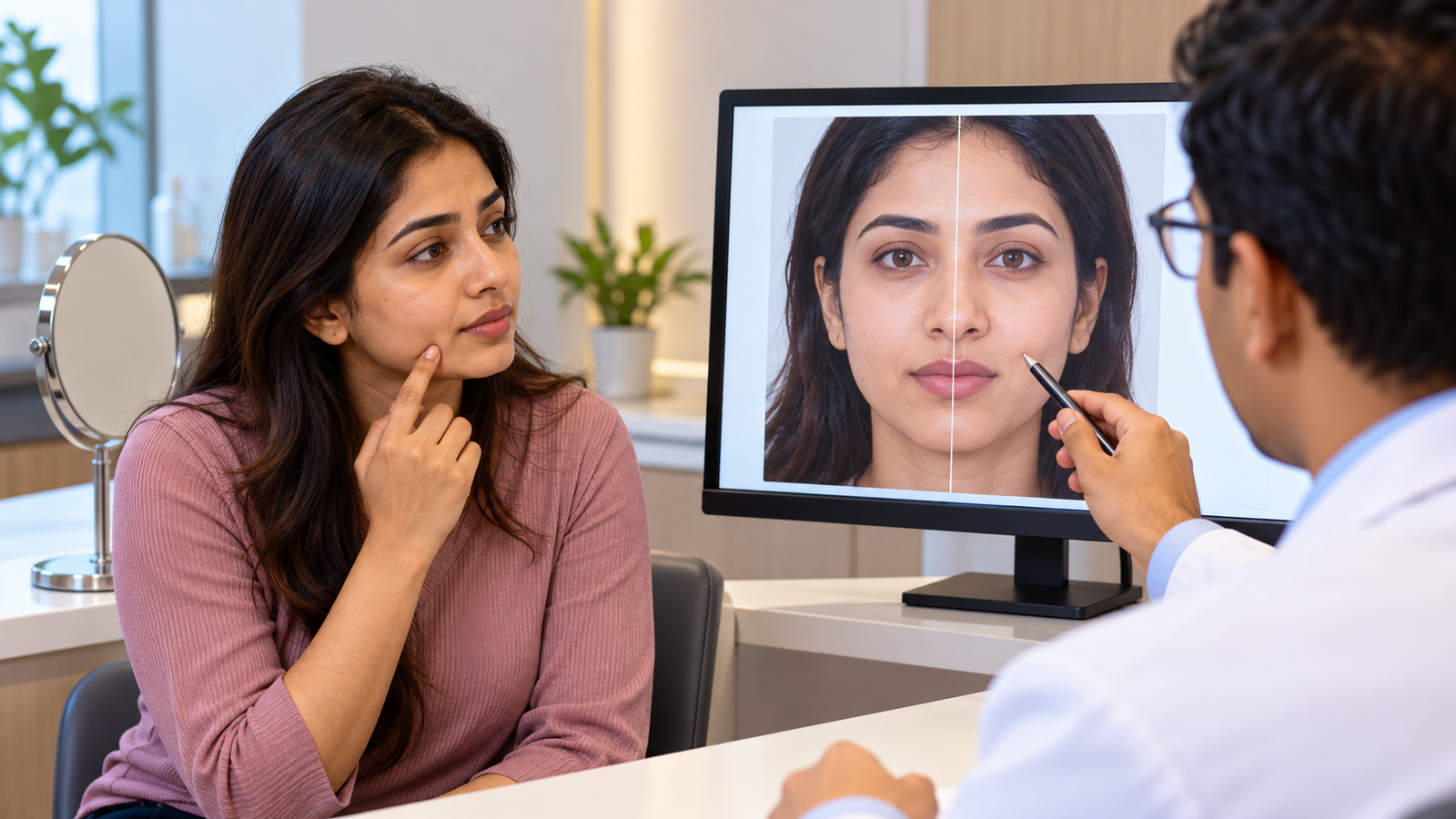
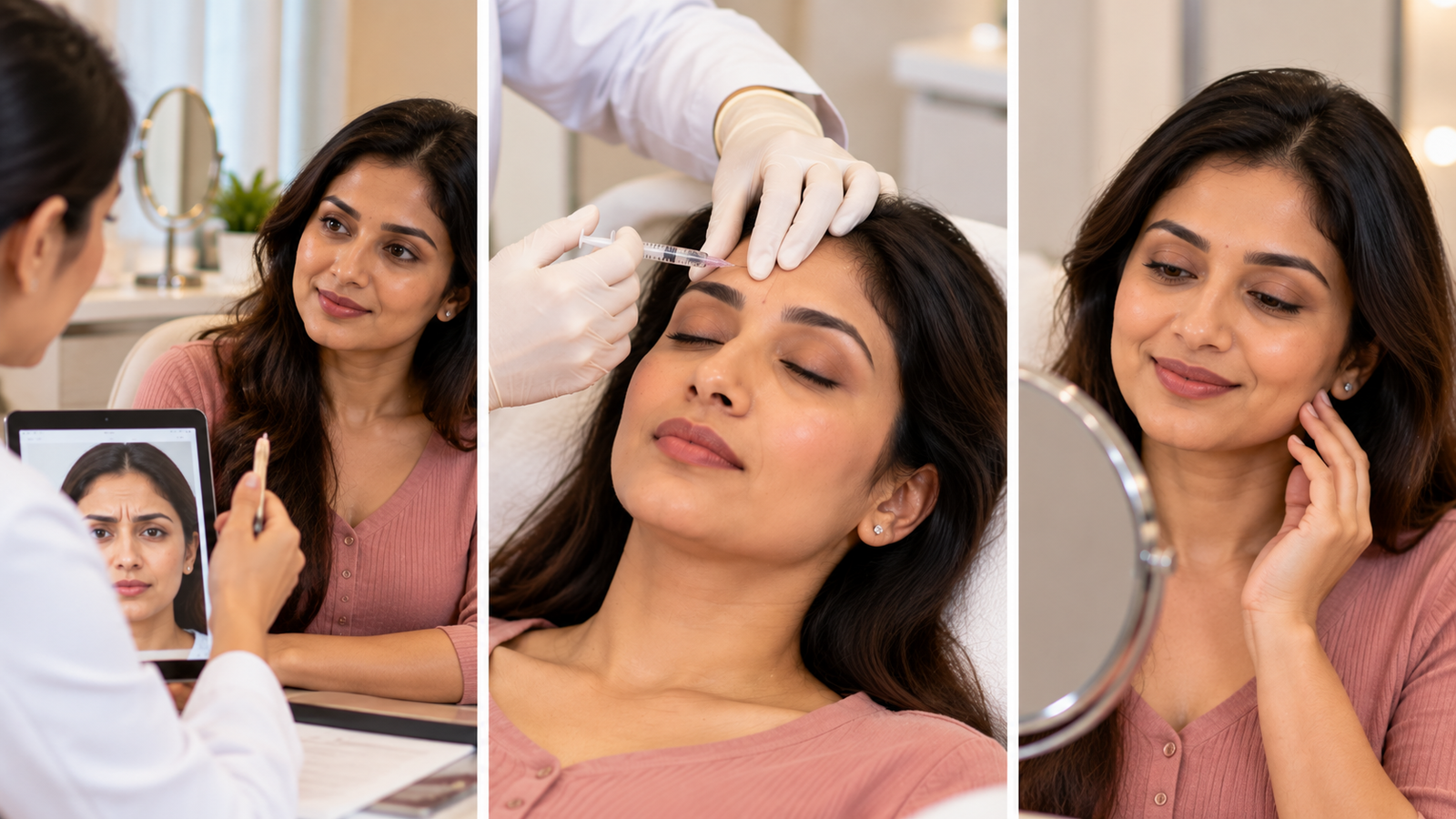
Asymmetry is measured by comparing standard photos of your face at rest and while moving. Our decision rule is simple: Botox is chosen only when the asymmetry changes with expression. A difference visible at rest in bone or volume is referred to filler or surgery.
Our assessment checklist:
- Photos at rest: front, left and right three-quarter views, in the same light.
- Animation photos: raised eyebrows, frown, eyes tightly closed, full smile, showing the lower teeth, pucker, and teeth clenched.
- Measuring brow height and mouth corner position on each side against the pupils.
- Feeling both jaw muscles while you clench, to separate muscle from bone.
- Checking eyelid height, since a low lid is a warning sign against forehead Botox.
- Asking about past palsy, dental work, injury and which side you chew and sleep on.
- Showing you the unflipped photos, because the mirror reverses the sides you are used to seeing.
In our clinic, the clench test alone often changes the plan, because a jaw that looks wider is sometimes bone, not muscle.
One eyebrow is higher than the other, can Botox help?
Yes, when the higher brow rises further as you talk or raise your eyebrows. If the lower brow is low because the eyelid is heavy or the skin has sagged, a brow lift or eyelid surgery may be needed instead.
How long does the balancing effect last?
The balancing effect usually lasts three to four months in the brow and smile muscles, and often longer in the jaw muscle. You start to see a change in three to five days, and the full result shows at about two weeks.
Because each side often needs a different dose, a review at two weeks lets us add small top-ups where needed. With regular sessions, some habitual muscle over-pull eases, and the gap between sessions may lengthen.
Where can you get face balancing treatment in Athwalines Surat?
Start with an assessment, not an injection. Dr. Ashutosh Shah, plastic surgeon, uses the photo checklist above to decide whether Botox, filler or surgery fits the cause, and treats palsy-related asymmetry alongside your neurologist or ENT doctor where needed.
If one side of your face bothers you, bring a few relaxed and smiling photos to your consultation. Knowing which layer is uneven is what makes the treatment work.
Medical disclaimer: This article is for education only and is not a substitute for assessment by a qualified doctor. Facial weakness that appears suddenly needs urgent medical review, not cosmetic treatment. Consult Dr. Ashutosh Shah or a qualified specialist before any treatment.
.png)