
First-Time Botox: What Happens From Consultation To The Two-Week Review
Written by Dr. Ashutosh A Shah, M.B.B.S., M.S., M.Ch., D.N.B., Plastic and Reconstructive Surgeon. Reg. no. [REG NO].
Medically reviewed by Dr. Ashutosh A Shah · Published 6 October 2026 · Last reviewed 6 October 2026
At a first Botox appointment the doctor maps how your muscles move, agrees the areas and units, cleans the skin and gives a few small injections in about 15 minutes. Softening starts in 2 to 4 days and peaks around day 14, when a review visit checks symmetry and decides whether a small top-up is needed.
Two refinements, from the product label rather than clinic habit. The label puts the first effect earlier, at one to two days, and the two-week review is a clinic convention rather than a published timepoint. Section 3 sets out what happens on which day.
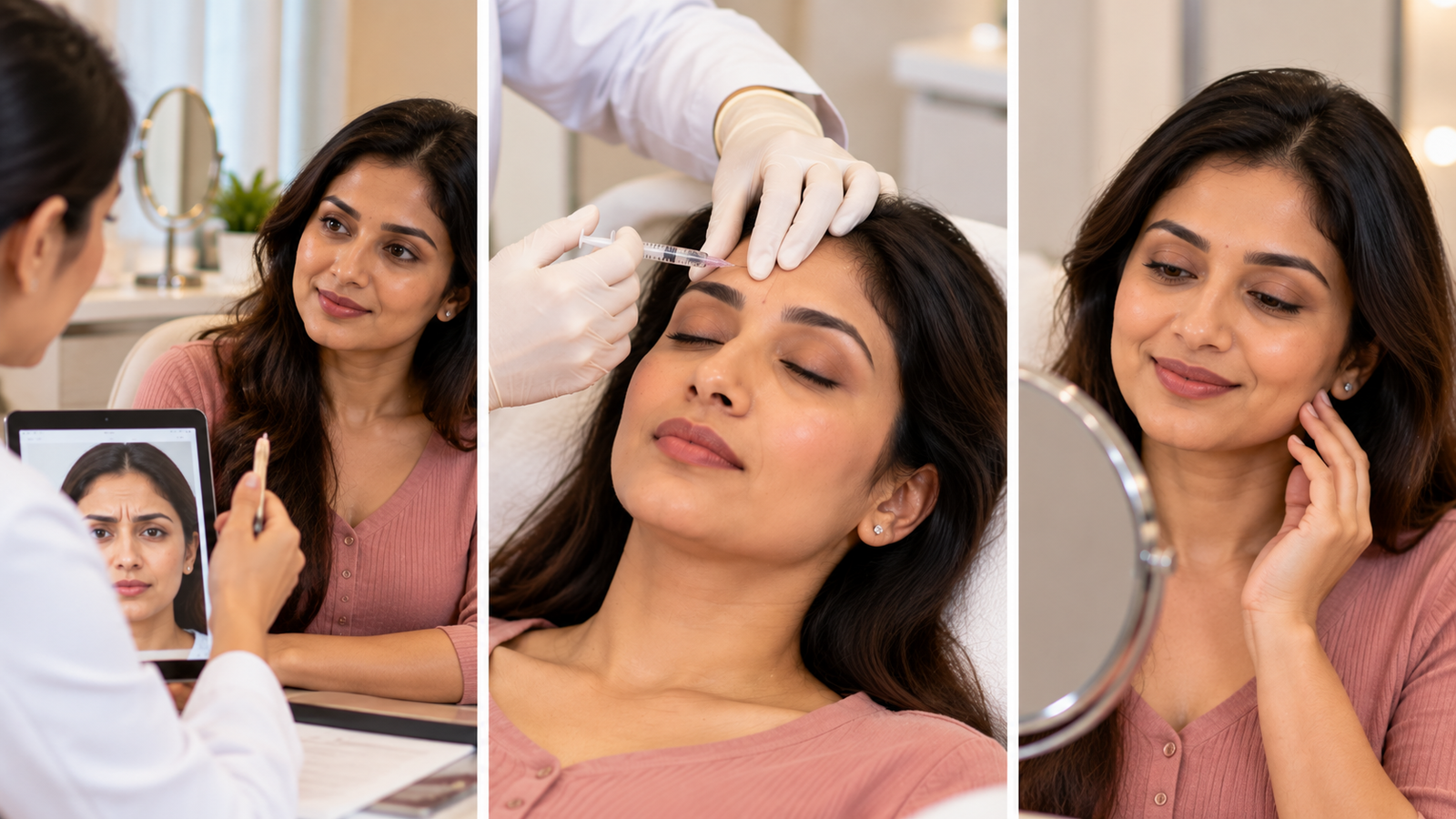
What is checked at the consultation before any injection, including at a botox consultation in adajan
How your face moves, not how it looks at rest. That is the point of the visit, and why a consultation that skips it is not a consultation.
What should happen:
- You are asked to make expressions. Frown, raise your brows, squeeze your eyes shut. Lines that only appear on movement respond to this treatment; lines that sit in the skin at rest often do not, and that decides whether you should be treated at all.
- Photographs at rest and at full expression. Not for marketing. They are the only way to judge your result at the review, because nobody remembers what their own forehead did a fortnight ago.
- Areas and units agreed out loud, against the labelled doses in section 2.
- Medical history taken properly. Pregnancy, breastfeeding, neuromuscular conditions and certain medicines all change the answer, and some of them rule the treatment out.
And one recommendation that surprises first-timers, which comes from the label rather than from the clinic. If you want your horizontal forehead lines treated, the prescribing information instructs: "Treat forehead lines in conjunction with glabellar lines (see Glabellar Lines Administration and Figure 1) to minimize the potential for brow ptosis."
In plain words: the forehead muscle lifts your brows, and the frown muscles pull them down. Weaken the lifter alone and the brow can drop. So being offered two areas when you asked for one is not an upsell here, it is the label's instruction, and a clinic that treats your forehead alone because you asked for one area is the one to worry about. The areas are covered separately on Botox for frown lines and Botox for horizontal forehead lines.
What happens during the 15 minutes of injections?
Very little, which nobody believes until they have done it. The skin is cleaned, the mapped points are injected one at a time with a very fine needle, and you sit up.
The numbers are set by the label, not by the clinic, and you are entitled to hear them:
- Frown lines: "Inject 4 Units (0.1 mL) of reconstituted BOTOX Cosmetic intramuscularly into each of 5 sites, 2 in each corrugator muscle and 1 in the procerus muscle for a total dose of 20 Units."
- Crow's feet: 24 Units, given as 4 Units at each of 3 sites per side, 6 injection points in total.
- Forehead lines with frown lines: 40 Units in total, 20 to the forehead and 20 to the frown area.
- The needle: the label specifies a 30 to 33 gauge needle, which is about as fine as needles get.
Each injection is a brief sting. No anaesthetic for most people and no sedation for anyone. You will have small raised bumps at each point for ten or twenty minutes, and often a pinprick of blood. Some swelling is ordinary, and our Gujarati post on whether Is swelling after Botox normal covers it.
Afterwards: stay upright for a few hours, leave the area alone rather than rubbing or massaging it, and skip the gym that day. That is the whole of the aftercare.
What changes day by day over the first two weeks?
Less than you expect on day one, more than you expect by week two. The label's own description is that the initial doses "induce chemical denervation of the injected muscles one to two days after injection, increasing in intensity during the first week".
| When | What you notice | What is normal | When to call |
|---|---|---|---|
| Day 0 | Nothing has changed yet. Small bumps at the injection points settle within the hour | Pinprick marks, a little redness, occasional bruising, mild headache | Only for a problem listed in section 5 |
| Day 1 to 3 | The first softening. The label puts initial effect at one to two days | Movement feels slightly heavy or unfamiliar. Bruising may appear now rather than on day 0 | Spreading redness or warmth at a point |
| Day 4 to 7 | Clear change, and the label describes the effect "increasing in intensity during the first week" | Uneven progress between the two sides. This is the stage people panic about and it is too early to judge | A drooping eyelid, or a brow that has clearly dropped |
| Day 14 review | The settled result. This is what you are judging, and the first fair comparison with your consultation photographs | Small asymmetries that a few units will correct. A review is not an admission of error | Bring anything that worried you, rather than calling ahead |
| Month 3 to 4 | Movement returning. The label gives a duration of "approximately 3-4 months" for frown lines | Lines reappearing gradually rather than all at once | Nothing. This is the point to book the next session |
Two notes on that table. The day 14 row is clinic practice rather than a published timepoint: the label's trial assessments were at day 7, day 30, day 60, day 90 and day 120, and the phrase "maximum effect" does not appear in it at all. Day 14 is chosen because it sits between the label's day 7 and day 30, which is where a first result is worth judging. And the duration figure is the label's. If you have been told six months anywhere, that is not in the prescribing information.
What is the two-week review for?
To judge the result against your own photographs, and to correct small asymmetries with a few units while that is still easy.
What a review visit looks at:
- Symmetry. Faces are not symmetrical to begin with and muscles on the two sides are rarely equally strong. A small difference at day 14 is a dosing observation, not a complication.
- Whether anything was under-treated. A conservative first dose is the right way to start, and the review is where it is adjusted upward. This is why starting conservatively costs you nothing.
- Brow position. Particularly if the forehead was treated, for the reason in section 1.
- What you actually think of it. Including if you dislike it, which is useful information rather than a complaint.
What a review cannot do is reverse anything. Units can be added; they cannot be taken away. That asymmetry is the argument for a cautious first dose, and why "we can always add more at two weeks" beats treating heavily and hoping. Practical details are in our Patient guide.
When should you call the clinic instead of waiting?
Most of what worries people in the first week resolves on its own or is settled at the review. These do not.
Call the same day for:
- A drooping upper eyelid, or an eyelid that does not open as fully as the other.
- Double or blurred vision.
- Difficulty swallowing, speaking or breathing, or new weakness anywhere in the body. Rare, but the reason this medicine carries a boxed warning about spread of toxin effect, and not something to sit on.
- Spreading redness, warmth or pus at an injection point, or fever.
- A severe or unusual headache that is not settling.
Wait for the review for: uneven progress between the sides, one brow sitting differently, a line that has not softened yet, mild heaviness, and bruising. All are normal at day 7 and most resolve or are easily corrected by day 14.
Next step
If this is your first time, the useful thing to bring is not a photograph of someone else. It is an answer to one question: which line bothers you when your face is moving. That is what this treatment addresses and what the consultation is built around. Expect to be photographed, to hear the units out loud, and to be offered a review at two weeks.
This page is for education and is not a substitute for examination. Botulinum toxin is a prescription medicine that must be prescribed and administered by a qualified doctor; it carries a boxed warning about the spread of toxin effect and is not suitable in pregnancy, breastfeeding, certain neuromuscular conditions or with some medicines. The doses, needle gauge, onset, duration of approximately 3 to 4 months and the three-month repeat statement quoted here are from the BOTOX Cosmetic prescribing information. The two-week review is this clinic's practice rather than a published timepoint; the label's own trial assessments were at day 7, day 30, day 60, day 90 and day 120. Your own result and timing may differ. Please consult Dr. Ashutosh A Shah about your own treatment.
.png)