
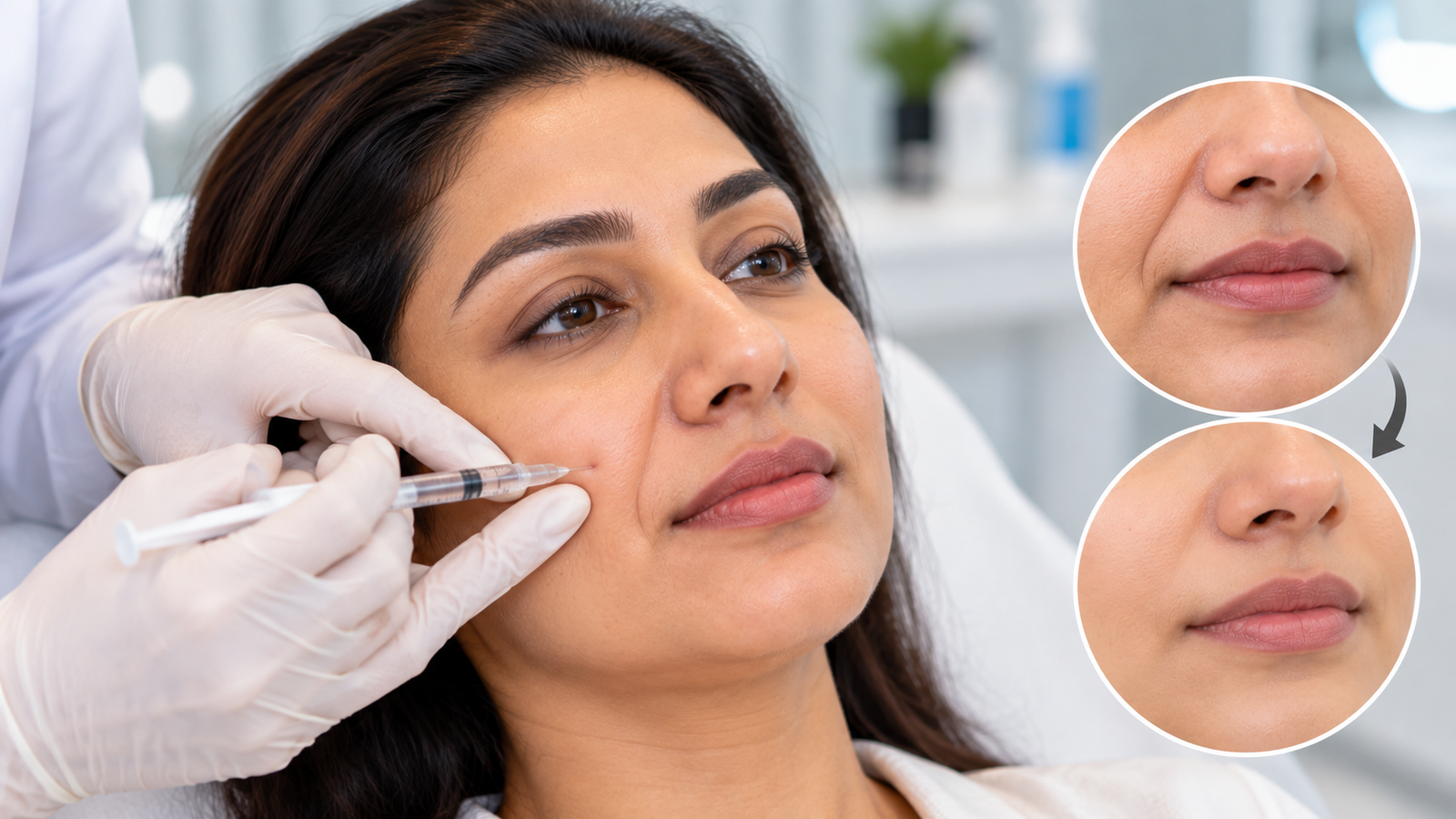
Nasolabial Fold Filler: When It Helps And When The Cheek Is The Real Answer
Nasolabial folds are often a shadow cast by a flattened cheek rather than a crease that needs filling. Supporting the cheek first frequently softens the fold with less product. Direct filling suits a genuine crease with good cheek support, and overfilling here is what creates a heavy, puffy look.
The lines running from the sides of the nose toward the corners of the mouth are called nasolabial folds. They are a normal part of facial anatomy and become more noticeable with facial movement, ageing, volume loss and changes in skin support.
This is why nasolabial fold filler should not automatically mean injecting filler directly into the fold. A proper facial assessment first determines whether the visible line comes mainly from the fold itself, loss of cheek support or broader skin laxity.
At Elegance Clinic, Surat, treatment planning focuses on assessing the entire mid-face, including cheek volume, skin support, facial proportions and the depth of the nasolabial fold. In some patients, restoring cheek support first may soften the nose-to-mouth fold and reduce the amount of filler required directly in the area.
Dr. Ashutosh A Shah, Board Certified Plastic and Reconstructive Surgeon, assesses whether the main concern is a genuine crease, loss of cheek support or broader skin laxity before planning treatment. The goal is to achieve natural-looking softening while avoiding excessive filler that can make the lower mid-face appear heavy or puffy.
Why Does the Nose-to-Mouth Fold Deepen With Age?
Nasolabial folds can become more noticeable for several reasons.
With age, the mid-face gradually loses volume and structural support. The cheek may look flatter, and soft tissue can shift downward. This creates a stronger shadow where the cheek meets the area around the mouth.
Skin also becomes less elastic over time. Repeated facial expressions can make an existing fold more noticeable, particularly when smiling.
The appearance can therefore result from a combination of:
- Mid-face volume loss
- Flattening of the cheeks
- Changes in facial fat distribution
- Reduced skin elasticity
- Repeated facial movement
- Natural facial anatomy
A person asking for smile lines filler may therefore need assessment beyond the smile line itself.
Treating only the visible crease without understanding what is creating it can lead to unnecessary product use.
For more information about treatment specifically for this area, see Nasolabial fold treatment in Surat.
When Is the Cheek the Real Target Rather Than the Fold Itself?
This is one of the most important decisions when planning nasolabial fold filler.
Imagine the cheek as structural support above the fold. When the mid-face loses volume and becomes flatter, the tissue below it can appear heavier and the nasolabial shadow becomes deeper.
In this situation, injecting the fold alone does not address the main reason it has become prominent.
Restoring carefully selected cheek support may soften the fold indirectly.
This approach can be particularly useful when examination shows:
- Flattened or deflated cheeks
- Mid-face volume loss
- A fold caused largely by shadow
- Good skin quality but reduced structural support
- Several signs of facial volume loss rather than one isolated crease
It does not mean everyone with nasolabial folds needs cheek filler. A person with good cheek support and a genuine crease at rest may be more suitable for direct treatment.
This is why cheek support for nasolabial folds should be decided from the whole face rather than from a close-up photograph of the mouth.
You can also read about Non-surgical facial contour correction to understand how different areas can be assessed together.
How Much Filler Is Realistic in This Area?
There is no single filler volume that is correct for every nasolabial fold.
The amount depends on the depth of the crease, facial anatomy, existing cheek support, skin quality, previous filler and whether one or both sides need treatment.
More product does not automatically produce a better result.
A conservative approach is especially important around the nose-to-mouth area because adding excessive volume can make the lower mid-face appear heavier.
Some patients may need only a relatively small amount directly in the fold. Others may benefit from treating the cheek first and then reassessing whether any direct filler for nose to mouth lines is still required.
Staging treatment can also be useful. Instead of attempting to erase a fold during one appointment, the face can be reassessed after the initial treatment has settled.
The aim should usually be to soften an excessive shadow or crease while preserving natural facial movement—not to completely remove a normal anatomical fold.
Assessment: What Should Be Treated First?
| What You See | First Target | Typical Product Volume | Realistic Improvement |
|---|---|---|---|
| Shadow mainly when smiling | Often observation or conservative treatment | Minimal if treatment is appropriate | Subtle softening while retaining natural expression |
| Defined crease visible at rest with good cheek support | Nasolabial fold | Conservative volume based on anatomy | Softer crease rather than complete removal |
| Flattened cheek with deeper fold below | Cheek support first | Individualised and often staged | Improved mid-face support with secondary softening of the fold |
| Loose lower face and significant skin laxity | Skin laxity rather than simply the fold | Filler may have a limited role | Requires assessment for other treatment options |
The volume shown in any treatment plan should always be individualised rather than treated as a fixed recommendation.
What Makes a Nasolabial Result Look Heavy or Shiny?
The nose-to-mouth region is not an empty space that needs to be filled until it becomes flat.
A nasolabial fold is a normal transition between facial structures. Attempting to erase it completely can require excessive volume and alter normal facial proportions.
Overfilling may make the area appear:
- Puffy
- Heavy
- Over-projected
- Unnaturally smooth
- Shiny under certain lighting
- Less natural during smiling
Repeatedly adding filler to the same area without reassessing the cheeks and surrounding face can also contribute to an overfilled appearance.
A natural laugh lines treatment should therefore focus on improvement rather than complete elimination.
Product selection, injection depth, placement and overall facial proportions all influence the final appearance.
Why Might My Doctor Treat My Cheeks Instead?
If you ask for treatment of your smile lines and your doctor recommends assessing the cheeks first, it does not necessarily mean the wrong area is being treated.
The cheek can influence the appearance of the nasolabial fold below it.
Where loss of mid-face support is the main problem, carefully restoring that support can reduce the shadow falling across the nose-to-mouth area.
After the cheek treatment settles, the fold can be reassessed.
If a genuine crease remains, a smaller amount of direct nasolabial fold filler may then be considered.
This staged approach may reduce the temptation to put excessive product directly into the fold.
What Are the Alternatives When Skin Laxity Is the Main Problem?
Filler works primarily by adding or restoring volume. It cannot remove substantial loose skin.
If the nasolabial area looks prominent mainly because the lower face has become lax or descended, repeatedly adding filler may make the face look heavier without correcting the underlying problem.
In these cases, the assessment needs to consider:
- Degree of skin laxity
- Cheek descent
- Jowling
- Overall facial volume
- Skin quality
- Lower-face proportions
Depending on the findings, other non-surgical or surgical options may need to be discussed instead of simply increasing filler volume.
Lines extending farther down from the mouth also need to be distinguished from nasolabial folds. Read about the Marionette line filler and Lines from mouth to chin treatment for these related concerns.
What Should a Nasolabial Fold Consultation Assess?
A good consultation should examine the face both at rest and during expression.
The assessment should consider:
- Depth of the fold
- Whether it appears only during smiling or remains at rest
- Cheek projection and volume
- Mid-face support
- Skin quality and laxity
- Facial symmetry
- Previous filler treatments
- Movement while smiling
- Overall facial proportions
The discussion should also establish what the patient expects.
Trying to completely erase every visible smile line is different from wanting a softer and more rested appearance. The second goal is often more compatible with maintaining natural facial anatomy.