
Bunny Lines and Nose Treatment in Surat
Written and medically reviewed by Dr. Ashutosh A. Shah, M.B.B.S., M.S., M.Ch., D.N.B., plastic surgeon, in practice since 2004. Every treatment described on this page is injected by Dr. Shah personally.
Three separate things bring people to this page: the diagonal lines that appear across the bridge of the nose when you scrunch it, a nasal tip that drops and looks longer when you smile, and the shape of the nose itself. The first two are muscle and both are off-label uses of botulinum toxin. The third is a filler question, and the nose is the single highest-risk site on the face for filler, accounting for more reported cases of filler-related vision loss than any other area. That last fact belongs at the top of this page rather than the bottom.
If you are here about the shape of your nose rather than about lines, read the section on filler risk before anything else.
Filler in the nose carries the highest reported risk on the face
This section comes first deliberately. In the largest published review of filler-related vision loss, covering 511 cumulative cases, the nose accounted for 40.6% of them. That is more than the forehead at 27.7% and more than the area between the brows at 19.0%. Of all those patients, 68.2% had no recovery of vision at all.
The mechanism is straightforward and it explains why the nose specifically. Filler placed into a blood vessel, or pressing hard enough to block one, stops the blood supply beyond that point. The vessels supplying the nose connect backwards towards the artery that feeds the retina, and the connections are rich, short and variable between people. So material introduced in the wrong place has a route to the eye, and the nose is where that route is shortest.
Two honest qualifications, because a number without them is either frightening or meaningless. Those 511 are reported cases gathered over more than a century of published literature, so no rate per treatment can be calculated from them and nobody can tell you your personal percentage. And the figure is not a reason to believe nose filler always goes wrong, because the great majority of treatments do not. What it is, legitimately, is the reason this is a slower conversation than any other injectable decision, the reason it belongs with someone who knows the anatomy of that region specifically, and the reason hyaluronidase should be in the room.
One thing that is not a reassurance, and is often offered as one. Hyaluronic acid filler can be dissolved, and in the reported cases of vision loss that did not restore sight for most of those patients. Reversibility is useful for a lump or an asymmetry. It is not a safety net for a blocked artery, and anyone presenting it as one has misunderstood the problem.
Which of the three brought you here?
Bunny lines across the bridge
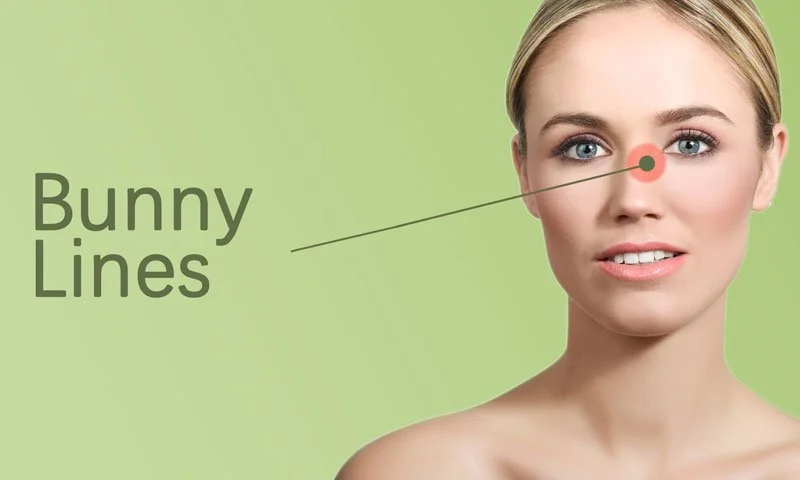
Diagonal lines running up and outwards on either side of the bridge of the nose, appearing when you scrunch, sniff or smile hard. They are made by the nasalis, a small muscle over the side of the nose, folding thin skin. They are dynamic in most people, which is why they respond to treatment at all.
A tip that drops when you smile
Here the complaint is that the nose looks fine at rest and longer or more hooked when smiling, with the tip pulled down. A small muscle running between the base of the nose and the upper lip pulls the tip downwards when you smile, and in some people it is strong enough to change the profile noticeably. Because it is a muscle doing it, a small off-label dose can soften the pull.
The shape of the nose itself
A bump on the bridge, a tip that sits low, a nose that looks asymmetrical or lacks definition. None of this is a muscle problem. It is structure, and the only injectable approach is filler, with the risk described above. Read the next paragraph carefully because it is the most common misunderstanding on the subject.
Filler adds to a nose. It cannot make one smaller
The phrase "non-surgical nose job" implies that an injection can do what surgery does, and it cannot, because the two work in opposite directions. Surgery can remove bone and cartilage. Filler only adds volume. What filler can do is camouflage: placing material above and below a bump can make the profile read as straighter even though the bump is still there, and adding support under a low tip can lift it slightly. What it cannot do is reduce the size of anything, narrow a wide nose, or remove a bump.
That distinction matters for two reasons. It is the difference between a result you will be happy with and one you will not, and a clinic that lets you believe filler will make your nose smaller has set up a disappointment it then has to manage. If what you want is a smaller or narrower nose, the honest answer is that this is a surgical question, and you should hear that before you pay for anything.
Why bunny lines sometimes show up after your frown lines are treated
This catches people out and it is worth knowing in advance. The muscles of the upper face work as a group, and when the frown muscles between the brows are relaxed, the small muscle at the side of the nose is often used more to produce the same expression. The result can be bunny lines that were not noticeable before treatment becoming noticeable after it, which feels like something has gone wrong when in fact the face has redistributed the work.
This is a recognised pattern rather than a complication, and it is described here from clinical observation, not from a published frequency, so nobody should tell you how likely it is for you. The practical consequences are simple. If you are being treated between the brows for the first time, it is worth asking about the nose at the same consultation, so that you are not surprised at the two-week review. And if you have already had frown-line treatment and the lines on your nose seem newly obvious, the explanation is usually this and not a mistake. The forehead and frown lines page covers the rest of that area in detail.
| Complaint | What causes it | What is used | What will not work | Label status |
|---|---|---|---|---|
| Bunny lines on the bridge | The small muscle at the side of the nose folding thin skin | A small dose of toxin to that muscle | Filler, which fills volume rather than relaxing muscle | Off-label |
| Tip drops when you smile | A muscle pulling the tip down on smiling | A small dose of toxin to that muscle | Filler in the tip, which adds weight not lift | Off-label |
| A bump on the bridge | Structure: bone and cartilage | Filler can camouflage it; surgery can remove it | Any injection, if the aim is to remove the bump | Highest-risk filler site |
| A nose that looks large or wide | Structure, not volume loss | A surgical question, honestly answered | Filler, which adds volume and cannot reduce size | Not an injectable problem |
What to expect, and what nobody can tell you precisely
For the toxin treatments, the first effect appears one to two days after injection and builds through the first week, with the result settled at about two weeks in this clinic's experience, which is when a review is offered. Doses here are small. In this clinic's experience the bunny lines take roughly two to four units into each side, which is a practice figure and not a regulated one, because the nose is not an approved indication. The muscles are small, they sit close to the muscles that move the upper lip and the corner of the mouth, and too generous a dose produces a changed smile rather than a better nose. This is an area where restraint is the technique.
On duration, there is no official figure for either nasal treatment, because neither is an approved indication. The three to four month figure in circulation belongs to the frown lines between the brows. What the label does state is that treating more often than every three months has not been evaluated, so three months is the floor whatever the area.
For filler, expect a longer consultation than you think you need, expect to be examined in profile and from below as well as face on, and expect to be told what cannot be achieved as clearly as what can. If a clinic is willing to inject your nose on the same visit you first asked about it, that is worth thinking about rather than being pleased by.
What it costs in Surat, and why no figure appears on this page
The cost depends on whether you are treating lines with toxin or shape with filler and on the product used, so any figure quoted before someone has examined your face is a guess. You are given a price after the assessment and before anything is injected, so you know the full cost while you can still say no. EMI options are available.
One warning worth taking seriously. A quote well below the going rate usually means one of three things: fewer units than the area actually needs, a product diluted further than it should be, or an injector who is not a doctor. The nose is the highest-risk filler site on the face, so it is the last place to shop on price. Ask which product is being used, how many units, and who is holding the needle, then compare those three answers rather than the totals.
Frequently Asked Questions
Is filler in the nose dangerous?
It carries the highest reported risk of any filler site on the face, and you should know the figure rather than a reassurance. In the largest published review, 511 cumulative cases of filler-related vision loss, the nose accounted for 40.6% of them, more than any other area, and 68.2% of those patients recovered no vision. Those are reported cases collected over more than a century, so no rate per treatment can be worked out and nobody can quote you a personal percentage. What it means practically is that this is a decision to take slowly, with someone who knows that anatomy specifically, in a room where hyaluronidase is available.
Can filler make my nose smaller?
No, and this is the most common misunderstanding about the treatment. Filler adds volume; it has no mechanism for removing any. What it can do is camouflage, so material placed above and below a bump can make a profile read as straighter while the bump itself is unchanged, and support under a low tip can lift it a little. It cannot narrow a wide nose or reduce the size of anything. If a smaller nose is what you want, that is a surgical question and you should be told so before you pay for an injection.
Does hyaluronidase make nose filler safe?
No, and it is important not to be sold that idea. Hyaluronidase dissolves hyaluronic acid filler and is genuinely useful for a lump, an asymmetry or an over-filled area. For a blocked artery it is a different matter: in the published cases of vision loss, most patients did not recover sight, and the filler being dissolvable did not change that. So hyaluronidase being available is a necessary condition for injecting filler, not a reason the injection is low risk. Treat a clinic that cannot confirm it is on the premises as having answered the question.
Why did I get bunny lines after my frown lines were treated?
Because the muscles of the upper face work as a group. When the frown muscles are relaxed, the small muscle at the side of the nose tends to be used more to make the same expression, so lines that were not obvious before can become obvious afterwards. It is a recognised pattern rather than a sign that something went wrong, and it is usually straightforward to treat at the two-week review. Nobody can tell you how likely it is in advance, because there is no reliable published frequency for it, so a clinic quoting you one is guessing.
Is Botox for bunny lines approved?
No, it is off-label, as is treatment of the muscle that pulls the nasal tip down. The BOTOX Cosmetic label is approved for four areas only: frown lines, lines at the outer corner of the eye, forehead lines and bands in the neck. Off-label use is routine in medicine and these are small, commonly performed treatments, but it means no official dose and no official duration exist for them, so the injector's judgement replaces a label. Doses here are small because the muscles are small and sit close to the muscles that move your upper lip; in this clinic's experience the bunny lines take roughly two to four units per side, which is this clinic's practice rather than an official figure.
Will treating my nose change my smile?
It can if the dose is too generous or placed too low, because the muscles treated here have close neighbours that lift the upper lip and the corner of the mouth. That is the specific risk to ask about, and the answer is restraint and placement rather than a different product. It is also why a first treatment in this area should be conservative with a review two weeks later, when a little more can be added if it is needed. The sequence only runs in one direction, which is the argument for starting low everywhere on the face and especially here.
Is treating the nose safe, and who should not have it?
The two muscle treatments are small and the risk is a changed smile if a dose sits too low, because the muscles here have close neighbours that lift the upper lip. Filler in the nose is a different order of risk and is covered at the top of this page. Botulinum toxin carries a boxed warning about the effect spreading beyond the injection site. It is avoided in pregnancy and breastfeeding, in certain neuromuscular conditions, with some medicines, and where there is infection at the site. Tell us about blood thinners and about any previous filler anywhere in the nose.
How much does nose treatment cost in Surat?
No figure appears here, and for this area the more important question is not the price but whether an injection is the right answer at all. The cost follows whether you are treating lines with toxin or shape with filler, and which product is used, both of which follow an examination. You are quoted afterwards and before anything is injected, and EMI options are available. For nasal filler specifically, a low quote is the wrong thing to be pleased about: this is the highest-risk filler site on the face.
Next step
Work out which of the three questions is yours before you come in, because they lead to very different conversations. Scrunch your nose in a mirror and look for the diagonal lines; smile and watch whether the tip drops; then look at your nose at rest, in profile, and ask yourself whether what bothers you is a line or a shape. If it is a shape, come prepared for a longer discussion in which you will be told plainly what an injection cannot do, and expect the risk above to be part of it rather than a footnote. You can book a consultation or read common questions on our FAQ page.
This page is for education and is not a substitute for examination. Botulinum toxin is a prescription medicine that must be prescribed and administered by a qualified doctor; it carries a boxed warning about the spread of toxin effect and is not suitable in pregnancy, breastfeeding, certain neuromuscular conditions or with some medicines. Both botulinum toxin uses described on this page are off-label: the BOTOX Cosmetic label is approved for glabellar lines, lateral canthal lines, forehead lines and platysma bands only. Because the nose is not an approved indication, no official unit dose or duration figure exists for these treatments. The unit range given here is this clinic's own practice figure and is stated as such. The one to two day onset and the three-month minimum interval are from the BOTOX Cosmetic prescribing information. The filler vision-loss figures are from a published review of 511 cumulative cases and describe reported cases rather than a rate per treatment; no rate of occurrence can be calculated from them. The pattern of bunny lines becoming more noticeable after frown-line treatment is described from clinical observation and no frequency is claimed for it. No surgical rhinoplasty service is claimed on this page; ask at consultation what is available. The two-week review and the settled-result timing are this clinic's practice rather than label timepoints. Please consult Dr. Ashutosh A. Shah about your own treatment.