
Bunny Lines On The Nose: Why They Appear After Frown Botox And How They Are Treated
Written by Dr. Ashutosh A. Shah, M.B.B.S., M.S., M.Ch., D.N.B., Board Certified Plastic Surgeon, Elegance Clinic. Reg. no. [REG NO]. In practice since 2004.
Medically reviewed by Dr. Ashutosh A. Shah · Published 13 October 2026 · Last reviewed 13 October 2026
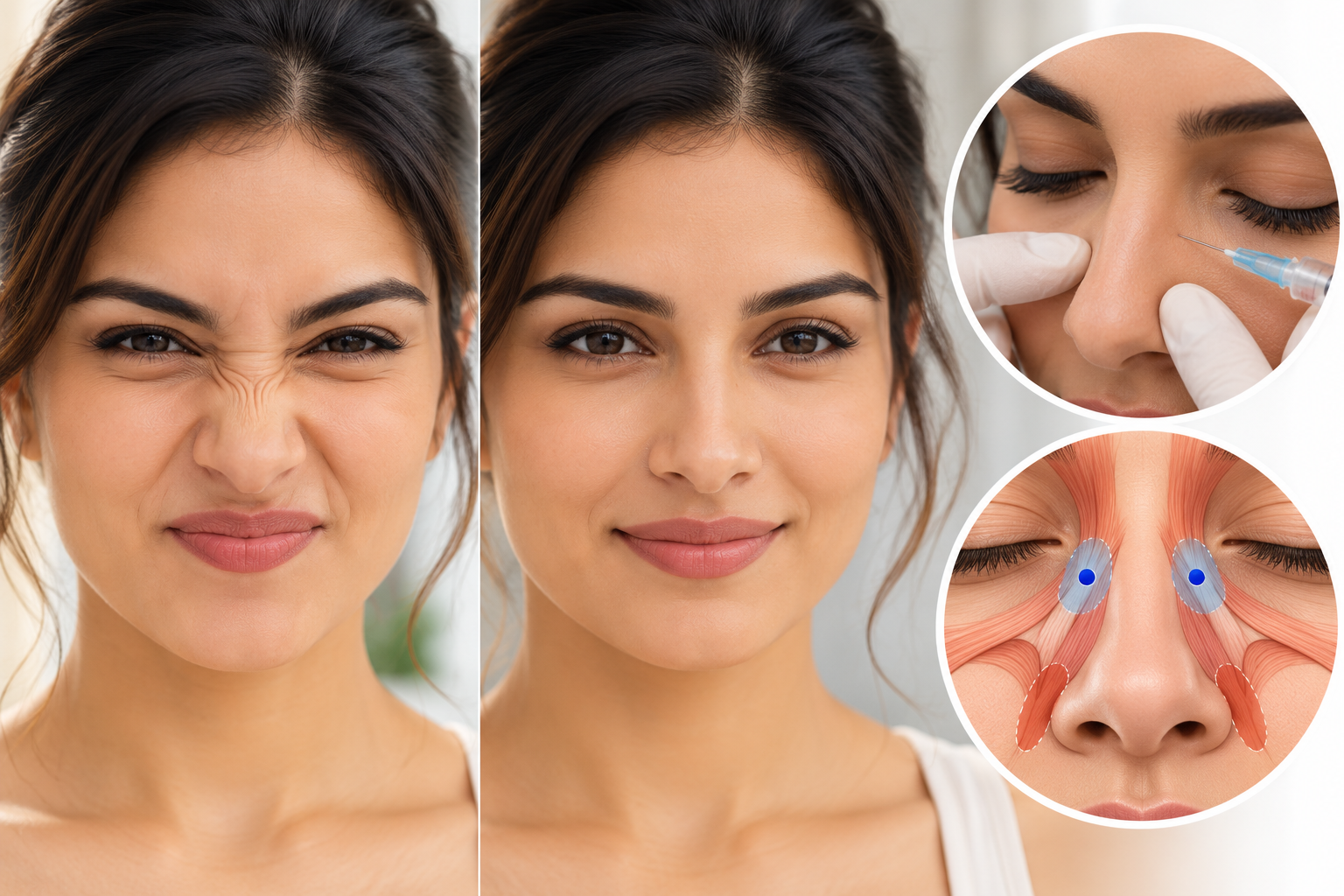
Bunny lines are diagonal creases on the sides of the nose that appear when you scrunch or laugh, caused by the nasalis muscle. They often become more noticeable after frown-line Botox, because the nose muscle takes over the movement. A small dose of Botox into the nasalis on each side softens them in about two weeks.
Why did I get bunny lines after Botox for frown lines? It is one of the most common questions at a two-week review, and it has a simple answer: the lines were often there before, and the nose muscle now does more of the work. This page explains bunny lines botox step by step: which muscle causes the lines, where the injection points sit, how many units are used, what can go wrong and how long it lasts. For the full range of options, see Bunny lines treatment options.
What are bunny lines and which muscle makes them?
Bunny lines on the nose are short diagonal creases that fan out from the bridge across the upper sides of the nose when you scrunch, laugh or frown. They are made by the nasalis muscle, a thin muscle across the nasal bridge and sidewalls. When it contracts, it pulls the skin into folds.
- Movement lines first: they show only when the muscle moves.
- Resting lines later: with age and sun damage, faint wrinkles on the nose bridge may stay at rest.
- Not only an age sign: they appear early in people who scrunch their nose a lot.
Our article on Treatment for nose lines explains the skin side of nose wrinkles.
Why do bunny lines show up after frown Botox?
Because when the frown muscles are relaxed, the nose muscle often takes over part of the scrunching movement. A review of injectable nose treatments in Cosmetic Dermatology notes that bunny lines are a frequent concern after the frown area is smoothed with botulinum toxin.
Two things usually happen together:
- Unmasking: the lines were there, but deep frown lines drew the eye. Once the frown smooths, the nose lines stand out.
- Compensation: with the frown muscles quiet, the face uses the nasalis more when expressing.
The compensation rule we follow: whenever Frown line Botox is given, nasalis movement is checked at the day-14 review. If bunny lines have appeared or deepened and they bother you, a small dose is added then.
Where are the injection points and how many units are used? Planning bunny lines treatment near Majura Gate Surat
One point on each side, high on the nasal sidewall, using a small dose. Published ranges run from about 2 to 5 units per side: the Cosmetic Dermatology review gives 3 to 5 units per side into the side of the nasal wall, and the 2004 consensus recommendations list a starting dose of 2 to 5 units at one point per side. Our page on Botox for bunny lines gives the clinic's own range.
Injection map checklist:
| Checklist item | What is done |
|---|---|
| Nasalis point per side | One point on each upper nasal sidewall, marked while you scrunch |
| Depth | Shallow, into the thin muscle on the sidewall |
| Units range | About 2 to 5 units per side in published ranges; the lowest dose that works is used |
| Danger zone to avoid | Low and lateral, near the groove beside the nostril, where the muscle that lifts the upper lip and nostril (levator labii superioris alaeque nasi) runs |
| Review at day 14 | Check movement, symmetry and the smile; top up only if needed |
Botox for the nose is an off-label use: the cosmetic product label covers frown lines and other approved areas, not the nose. This is discussed before treatment.
What can go wrong if the dose spreads?
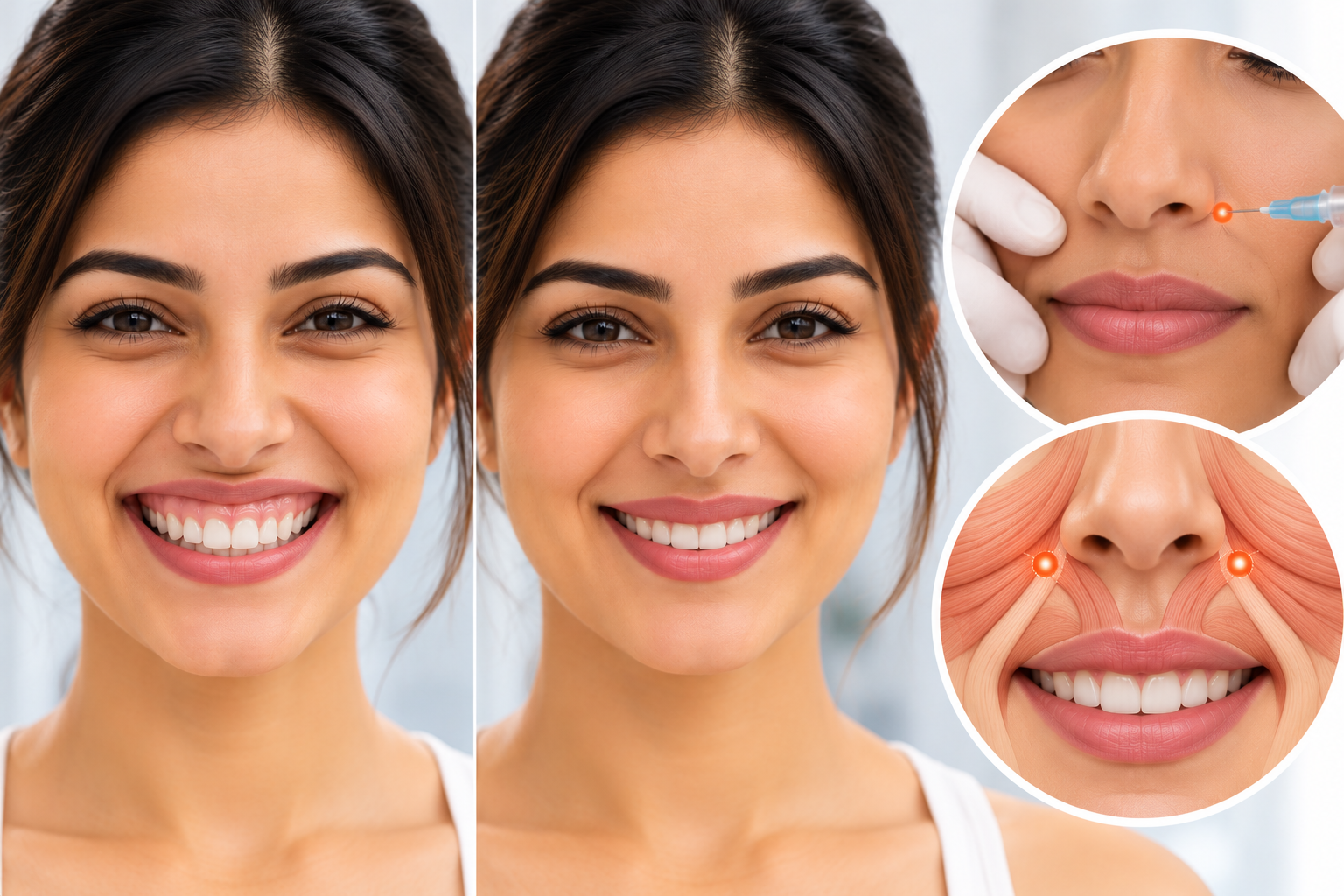
The main risk is a drooping or uneven upper lip. The Cosmetic Dermatology review warns that injecting too low, towards the groove between nose and cheek, can affect the levator labii superioris alaeque nasi, the muscle that lifts the upper lip. This is the usual cause of bunny lines botox gone wrong.
- Lower or uneven upper lip, most visible when smiling.
- A stiff look across the nose if the dose is high.
- Uneven lines, if one side is weaker than the other.
- Minor bruising at the injection points.
These effects are temporary and fade as the dose wears off, usually over weeks. The way to prevent them is a high injection point, a small dose and no rubbing of the area on the day of treatment.
How long do results last?
Usually about three to four months, similar to frown lines, though there is no labelled duration for the nose because it is off-label. The effect begins within a few days and is complete at about two weeks, which is why the review is set at day 14.
- Days 2 to 5: movement starts to soften.
- Day 14: full effect; review and top-up if needed.
- Months 3 to 4: movement gradually returns.
Next step
If bunny lines appeared after frown treatment, mention it at your day-14 review or book an assessment. A short scrunch test in clinic shows whether the nasalis is the cause and how small a dose is needed.
This page is for education and is not a substitute for assessment. Botox for bunny lines is an off-label use. Unit ranges are from published sources, and the dose for you is decided after examination. The injection map is an illustration, not a guide for self-treatment. Please consult Dr. Ashutosh A. Shah about your own treatment.
.png)