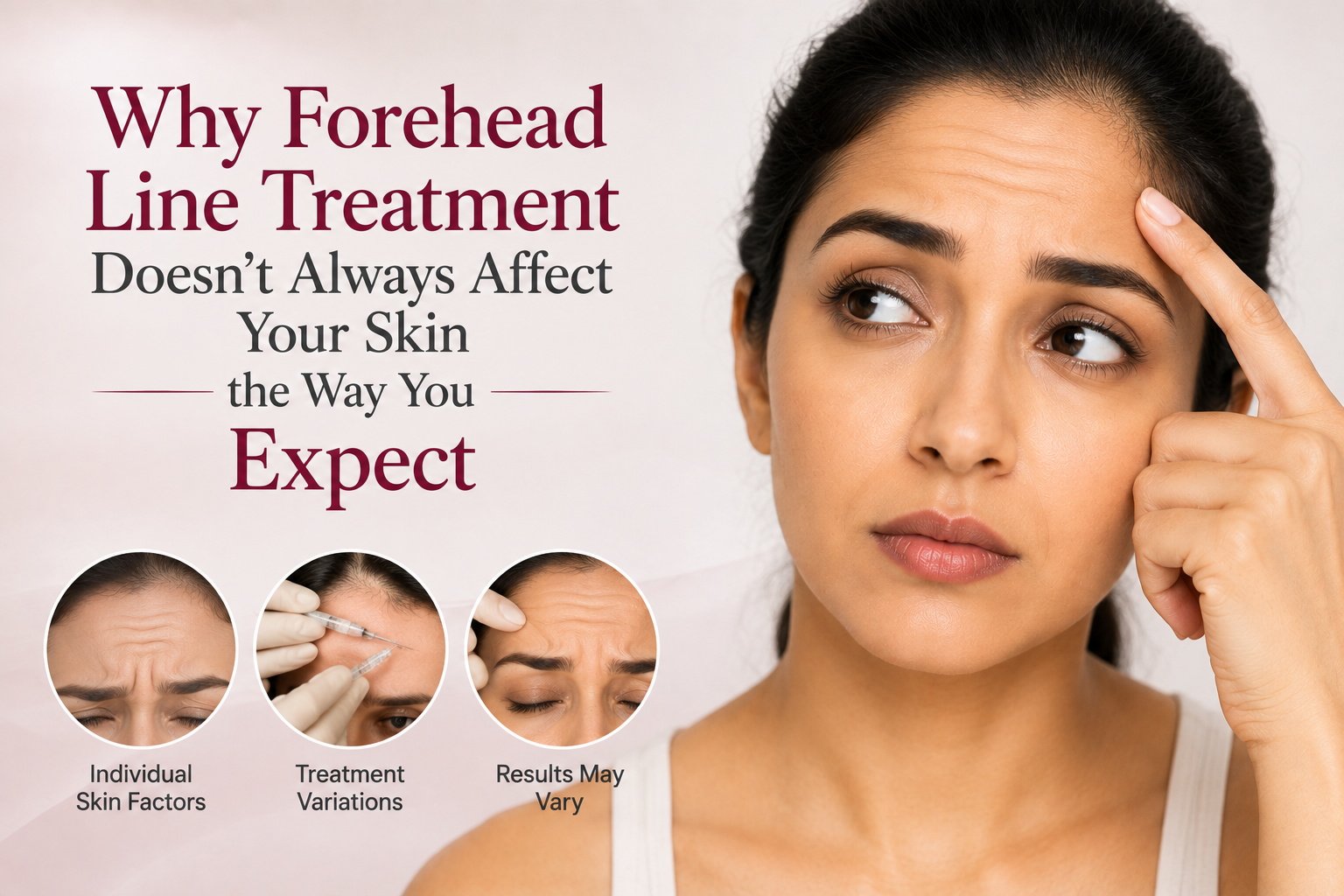
Why Forehead Line Treatment Doesn’t Always Affect Your Skin the Way You Expect
Forehead lines are among the most noticeable facial lines because the forehead moves constantly when we raise our eyebrows, concentrate, react, or express surprise. When these lines become more visible, many people consider treatments such as Botox to create a smoother appearance.
But one question often comes before treatment: Can treatment damage forehead skin?
In most cases, properly performed Botox treatment for horizontal forehead lines does not damage the skin. Botox works mainly by temporarily reducing the activity of specific muscles responsible for repeated facial movement. However, the treatment can cause temporary reactions such as redness, swelling, tenderness, bruising, or mild discomfort at the injection sites.
The important point is that the result depends not only on the product being used, but also on where it is injected, how much is used, the patient's facial anatomy, and the experience of the treating medical professional.
Can Treatment Damage Forehead Skin?
Botox treatment for forehead lines does not normally damage healthy forehead skin when it is appropriately selected and administered by a qualified medical professional.
Unlike procedures that intentionally remove or resurface layers of skin, Botox does not work by peeling, burning, cutting, or mechanically removing the skin. It temporarily reduces muscle activity underneath the skin, which can make dynamic forehead lines appear softer.
However, no cosmetic treatment is completely free from potential side effects. Some people may experience temporary injection-site reactions, while inappropriate treatment can produce unwanted cosmetic effects.
This distinction is important: temporary treatment-related skin reactions are not necessarily the same as permanent skin damage.
What Actually Happens to Your Forehead During Botox Treatment?
To understand whether Botox can harm forehead skin, it helps to understand what the treatment is designed to do.
When you repeatedly raise your eyebrows, the underlying forehead muscle contracts. Over time, repeated movement can contribute to the development of horizontal forehead lines.
Botulinum toxin works by temporarily interfering with nerve signals that cause targeted muscles to contract. With reduced muscle activity, the skin is subjected to less repetitive folding.
As a result:
- Existing dynamic lines may appear softer.
- The forehead may look smoother.
- Repeated muscle movement is temporarily reduced.
- The skin itself is not intentionally damaged or removed.
This is why Botox for horizontal forehead lines is fundamentally different from treatments that physically resurface the skin.
The Skin May Look Different After Treatment - But That Doesn't Mean It Is Damaged
One reason people ask “Can treatment damage forehead skin?” is that the forehead can look or feel slightly different immediately after injections.
For a short period, some patients may notice:
- Small raised areas around injection points
- Mild redness
- Localized swelling
- Tenderness
- Bruising
- A feeling of tightness
- Mild headache or discomfort
These effects can occur after injections and generally improve as the treatment area settles.
The appearance of temporary redness or small bumps should therefore not automatically be interpreted as skin damage.
If symptoms are severe, persistent, worsening, or unusual, medical advice should be sought rather than assuming the reaction is normal.
Does Botox Thin the Forehead Skin?
This is another concern that is often confused with muscle relaxation.
Botox is not designed to thin the skin. Its primary action is on nerve-to-muscle communication, not on the thickness of the skin itself.
However, facial appearance can change over time for many reasons, including:
- Natural aging
- Changes in collagen and elastin
- Sun exposure
- Genetics
- Weight changes
- Repeated facial movement
- Skin-care habits
- Hormonal changes
Therefore, if someone's forehead looks different months or years after treatment, it does not necessarily mean Botox has damaged or thinned the skin.
A proper assessment is needed to determine what is actually responsible for the change.
What Most People Don't Know: The Forehead Is Not Just About Wrinkles
Treating forehead lines is more complicated than simply placing injections wherever a wrinkle is visible.
The forehead muscles contribute to eyebrow movement and facial expression. If muscle activity is reduced too aggressively or injections are placed without considering the patient's anatomy, the result may not look natural.
Potential unwanted effects can include:
- A heavy forehead appearance
- Temporary brow drooping
- Eyelid or eyebrow changes
- Facial asymmetry
- Reduced natural expression
- An uneven appearance
This is why conservative treatment and careful assessment are important.
The objective should not simply be to make every line disappear. A good treatment plan considers facial balance, eyebrow position, muscle strength, skin quality, and the patient's desired appearance.
Can Too Much Botox Cause Problems?
Using more product does not necessarily mean getting a better result.
Excessive treatment may overly weaken muscles that contribute to eyebrow elevation and expression. For some patients, this can contribute to an unwanted heavy or lowered brow appearance.
The forehead also has individual anatomical differences. Two people with similar-looking wrinkles may require different treatment approaches.
A responsible practitioner therefore considers factors such as:
- Strength of the forehead muscles
- Existing eyebrow position
- Degree of forehead movement
- Facial symmetry
- Previous cosmetic treatments
- Skin characteristics
- Desired level of movement
The goal is generally controlled relaxation rather than complete immobilization.
Can Forehead Botox Cause Permanent Skin Damage?
Permanent skin damage is not the expected outcome of properly performed Botox treatment.
Most treatment-related reactions are temporary. Nevertheless, complications can occur, particularly if treatment is performed improperly or if an individual has an unexpected reaction.
This is why patients should avoid choosing a provider based solely on price or promotional offers.
Before treatment, it is reasonable to ask:
- Who will perform the injections?
- Is the practitioner medically qualified?
- How will my forehead muscles and eyebrows be assessed?
- What side effects should I expect?
- What happens if I experience an unwanted effect?
- Is the treatment appropriate for my facial anatomy?
These questions can help patients make a more informed decision.
Why Injection Technique Matters More Than People Realize
When people search “Can treatment damage forehead skin?”, they often focus entirely on Botox itself.
But treatment quality also depends heavily on the assessment and injection technique.
A skilled practitioner evaluates the face before deciding where and how much treatment may be appropriate. This can help reduce the likelihood of an unnatural result.
At Elegance Clinic, forehead-line treatment can be approached with attention to facial movement, proportions, and individual anatomy. Dr. Ashutosh Shah can assess the patient's forehead lines and facial characteristics to determine whether Botox is an appropriate option.
The purpose is not simply to eliminate every visible line but to achieve a balanced and natural-looking improvement.
Does Forehead Botox Stop You From Making Facial Expressions?
Not necessarily.
A carefully planned treatment can reduce excessive muscle activity while preserving some natural facial movement. The amount of movement that remains depends on factors such as dosage, injection placement, muscle strength, and individual response.
This is particularly important for people who want smoother forehead skin but do not want their face to appear completely expressionless.
The ideal outcome varies from person to person, so treatment should be individualized rather than based on a standard injection pattern.
What Can Help Protect Forehead Skin Before and After Treatment?
Although Botox itself is not a skin-resurfacing treatment, maintaining healthy skin can support the overall appearance of the forehead.
Useful habits include:
1. Protect Your Skin From the Sun
Regular sun protection helps reduce cumulative UV-related skin damage, which can contribute to premature lines and changes in skin texture.
2. Avoid Unnecessary Manipulation
After injections, follow the specific aftercare instructions provided by your treating professional rather than repeatedly touching or massaging the treated area.
3. Follow Professional Advice
Your practitioner may provide individualized instructions depending on your treatment and medical history.
4. Don't Chase a Completely Line-Free Forehead
Some facial movement is natural. Trying to eliminate every line may result in excessive treatment and an unnatural appearance.
5. Report Unexpected Symptoms
If you develop symptoms that concern you after treatment, contact your healthcare provider promptly.
Is Botox Suitable for Everyone With Forehead Lines?
No.
Forehead lines can have different causes, and Botox is particularly useful for lines associated with repeated muscle movement. Static lines that remain visible when the face is relaxed may require a different or combined approach.
A consultation can help determine whether Botox is suitable or whether another treatment may better address the individual's concern.
People should also disclose relevant medical history, medications, previous cosmetic procedures, allergies, and any previous reactions to injectable treatments before undergoing Botox.
Botox vs. Skin Resurfacing: Why the Difference Matters
It is useful to separate two different treatment goals.
Botox:
Primarily targets muscle activity that contributes to dynamic expression lines.
Skin resurfacing treatments:
Primarily target skin texture, pigmentation, scars, or surface-level changes.
Therefore, if someone asks “Can treatment damage forehead skin?”, the answer depends partly on which treatment they mean.
Botox does not intentionally remove the outer layer of skin. Other cosmetic procedures may work directly on the skin and therefore have different risks, recovery periods, and aftercare requirements.
When Should You Seek Medical Advice After Forehead Botox?
Mild redness, swelling, bruising, or tenderness can occur after injections. However, patients should contact their healthcare provider if they experience concerning or persistent symptoms.
Seek prompt medical attention for serious or unexpected symptoms, particularly difficulty breathing or swallowing, significant weakness, severe allergic symptoms, or other symptoms that feel medically concerning.
Understanding potential warning signs is an important part of making any cosmetic treatment decision.
How Long Does Forehead Botox Last?
Botox is temporary. The visible effect generally develops over the days following treatment and gradually wears off as nerve-to-muscle communication recovers.
The duration varies between individuals and depends on factors such as:
- Treatment area
- Dose
- Muscle strength
- Individual metabolism
- Previous treatment history
- How the individual responds to Botox
Because results are temporary, repeat treatment may be considered if the patient remains a suitable candidate.
Key Takeaways
- Can treatment damage forehead skin? Properly performed Botox does not normally damage healthy forehead skin.
- Botox primarily works by temporarily reducing targeted muscle activity.
- Temporary redness, swelling, tenderness, or bruising can occur after injections.
- Excessive treatment can create unwanted effects such as a heavy-looking forehead or temporary brow changes.
- Botox does not intentionally thin or resurface the forehead skin.
- Treatment should be customized according to facial anatomy, muscle activity, and aesthetic goals.
- Static forehead lines may require a different treatment approach than dynamic lines.
- Choosing an appropriately qualified medical professional is important for safety and natural-looking results.
Conclusion
So, can treatment damage forehead skin?
For Botox used to treat horizontal forehead lines, skin damage is not the intended effect and is not normally expected when the treatment is appropriately performed. Temporary injection-site reactions can occur, while problems such as brow changes or an unnatural appearance are more closely related to factors such as treatment planning, dosage, injection placement, and individual anatomy.
The safest approach is to have your forehead assessed by a qualified medical professional rather than assuming that every forehead line requires the same treatment.
If you are considering forehead line treatment in Surat, a consultation at Elegance Clinic can help determine whether Botox is appropriate for your lines, facial movement, and aesthetic goals.
Want to know whether your forehead lines are suitable for Botox? Schedule a consultation with Dr. Ashutosh Shah to discuss your options and expected results.