.png)
Masseter Reduction In Surat: Jaw Slimming Dose, Timeline And Limits
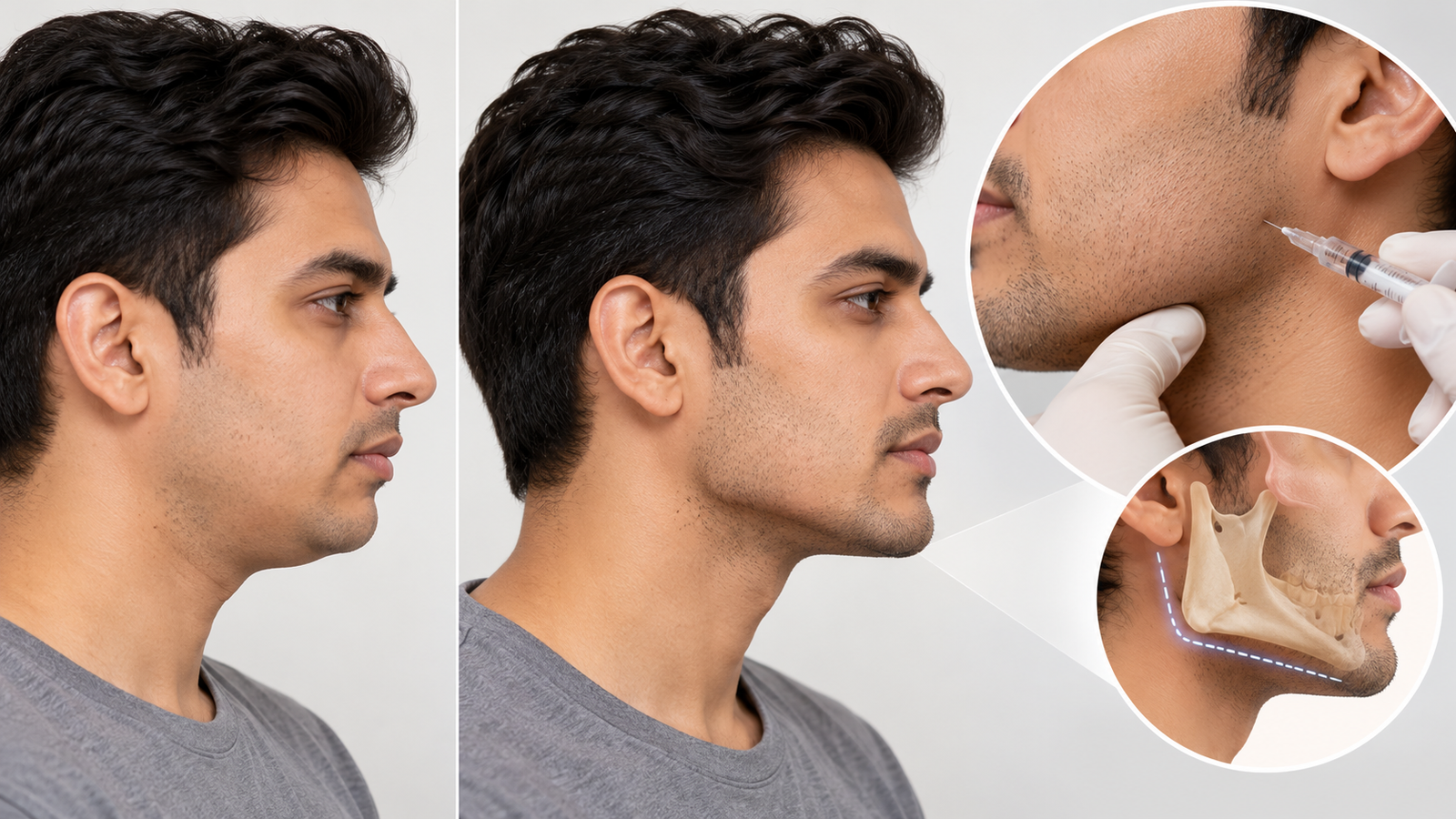
<style type="text/css"> </style> Masseter injections relax the chewing muscle so it gradually reduces in bulk, narrowing a square jaw. Visible slimming usually starts at four to six weeks and peaks around three months. Results commonly hold four to six months, longer than facial line treatment, and are then repeated.
At Elegance Clinic, Dr. Ashutosh Shah assesses whether lower-face width comes mainly from the masseter muscle, jaw bone, facial fat or a combination. This distinction matters because injections can reduce muscle bulk, but they cannot narrow a naturally wide jaw bone.
What Makes a Jaw Look Square: Muscle, Bone or Fat?
A wide or square lower face does not always mean the masseter muscles are enlarged.
Several structures can contribute to jaw width.
1. Masseter Muscle Bulk
The masseter is a strong chewing muscle located at the side of the jaw.
Some people naturally have prominent masseters, while frequent clenching or heavy chewing may make the muscles appear more pronounced.
When the muscle contributes substantially to lower-face width, relaxing it can gradually reduce its bulk.
This is the group most likely to notice a slimming effect from masseter injections.
The Prominent square jaw treatment page provides more information about treating muscular lower-face width.
2. Jaw Bone Width
Some people have a naturally broad lower jaw because of skeletal anatomy.
If the mandible itself is wide, relaxing the masseter does not make the bone narrower.
A patient may still notice some reduction if enlarged muscle sits over the bone, but injections cannot reproduce the change that would require altering skeletal width.
This limitation needs to be explained before treatment.
3. Buccal and Lower-Face Fat
Facial fat can also make the lower face appear broad.
Reducing muscle activity does not directly remove facial fat.
A patient whose width comes mainly from fat may therefore see little change from masseter treatment even if the injections work exactly as intended.
4. Mixed Jaw Width
Many patients have more than one contributing factor.
For example, someone may have:
-
A moderately broad jaw bone
-
Enlarged masseter muscles
-
Some lower-face fat
In that situation, injections may soften the muscular component without completely transforming the underlying facial shape.
That is why assessment should come before promising a V-shaped face.
Jaw Assessment: Will Masseter Injections Actually Help?
| Cause of Jaw Width | Does Injection Help? | Dose & Session Plan | When Change Shows | If Unsuitable |
|---|---|---|---|---|
| Masseter muscle bulk | Often, when muscle is the main cause | Individual dose based on muscle strength; treatment may be staged | Usually begins around 4–6 weeks and develops further over the following months | Reassess diagnosis if response is limited |
| Wide jaw bone | Cannot narrow the bone | Injection only if muscle bulk also contributes | Only muscular reduction will appear | Surgical assessment may be needed for major skeletal change |
| Buccal/lower-face fat | Does not directly remove fat | Masseter treatment only if muscle also contributes | Depends on muscular component | Consider assessment for the actual source of fullness |
| Mixed muscle, bone and fat | May improve the muscular component | Individualised and potentially staged | Gradual change | Combined or alternative treatment may be needed |
The important question is therefore not simply, “Do I have a square jaw?” It is, “Which structure is making my jaw look wide?”
How Do Masseter Injections Slim the Jaw, and How Long Does the Change Take?
Masseter injections reduce the activity of the chewing muscle.
This does not instantly remove muscle volume.
Instead, reduced activity allows the muscle to gradually become less bulky. That is why jaw slimming injections have a slower visible effect than injections used for expression lines.
Early Period
The treatment begins affecting muscle activity before a major cosmetic difference in jaw width becomes visible.
Some patients may notice a change in muscle tension earlier than they notice a change in photographs.
Four to Six Weeks
Visible slimming commonly starts around the four-to-six-week point.
The lower face may begin to look less square when viewed from the front.
Around Three Months
The slimming effect generally becomes more established over the following months, with the plan identifying around three months as the point at which the effect can peak.
This delayed result is important for patients who expect an immediate V-shaped face after their appointment.
Adding more treatment too early simply because the jaw still looks broad in the first few weeks may not be appropriate.
Four to Six Months
According to the treatment plan, results commonly hold for approximately four to six months.
As muscle activity returns, repeat treatment may be considered according to the patient's response and treatment goals.
For a broader explanation of muscular jaw reduction, see Jaw muscle reduction treatment in Surat.
What Dose Range Is Typical, and Why Is It Staged Over Two Sessions?
There is no single masseter botox dose suitable for every patient.
The appropriate amount depends on factors such as:
-
Muscle size
-
Muscle strength
-
Facial width
-
Right-to-left symmetry
-
Previous treatment
-
Desired degree of reduction
-
Chewing function
-
Individual response
A person with very strong, bulky masseters may require a different plan from someone with only mild muscular prominence.
For that reason, treatment should be based on clinical assessment rather than copying another patient's unit count.
Why Can Treatment Be Staged?
A staged approach allows the clinician to assess the initial response before deciding whether additional treatment is appropriate.
This can be useful because the visible slimming effect develops gradually.
The first treatment establishes how the muscles respond. A review can then assess:
-
Whether both sides are responding evenly
-
Whether enough muscle activity remains for comfortable chewing
-
Whether the jaw is becoming narrower as expected
-
Whether the original width was partly skeletal
-
Whether any further treatment is actually needed
Staging therefore prioritises control rather than simply using the largest possible dose at the first appointment.
The source plan requires a real dose-and-staging section, but it does not provide a numerical unit range. Exact unit figures should therefore be added only after Dr. Shah's clinical sign-off rather than invented for publication.
What Are the Side Effects, Including Chewing Fatigue and Asymmetry?
Masseter treatment affects a muscle used for chewing, so patients need to understand both cosmetic expectations and functional effects.
Chewing Fatigue
Some patients may notice temporary chewing fatigue, particularly when eating foods that require prolonged or forceful chewing.
This can happen because the treatment intentionally reduces masseter activity.
The aim is controlled relaxation rather than eliminating normal chewing function.
Temporary Weakness
A heavy treatment can potentially make the jaw feel weaker than expected.
This is another reason dose selection should be based on muscle size and strength.
Asymmetry
Most faces have some natural asymmetry.
One masseter may also be stronger or larger than the other. If both sides are treated identically without accounting for this difference, the result may not be balanced.
Assessment should therefore compare the right and left sides before treatment.
A review visit can determine whether the response is symmetrical or whether the plan needs adjustment.
Changes in Lower-Face Appearance
Reducing a bulky masseter changes the contour of the lower face.
That is the intended effect, but the amount of slimming should still suit the patient's overall facial proportions.
Making the jaw as narrow as possible is not necessarily the correct aesthetic goal.
Who Will Not Get the Result They Want From Injections Alone?
The main limitation of masseter reduction treatment in Surat is simple: it reduces muscle bulk, not every cause of a broad lower face.
Patients With a Broad Mandible
If the underlying jaw bone is responsible for most of the width, injections cannot make that bone narrower.
The patient may require a surgical assessment if substantial skeletal narrowing is the goal.
Patients Whose Fullness Comes Mainly From Fat
Masseter treatment does not directly reduce buccal or lower-face fat.
Treating the muscle when fat is the primary problem may therefore produce little visible improvement.
Patients Expecting an Immediate Result
Jaw slimming develops gradually.
Someone expecting a dramatic change immediately after treatment may be disappointed even when the treatment is working normally.
Patients Expecting a Completely Different Face Shape
Masseter reduction can soften muscular width, but it cannot change every aspect of facial anatomy.
The V shape face treatment in Surat guide can help explain how different structures may contribute to the overall lower-face shape.
Is Masseter Reduction the Same as a V-Shape Face Treatment?
Not exactly.
Masseter reduction describes treatment directed specifically at enlarged masseter muscles.
“V-shape face” describes an aesthetic goal rather than a single anatomical treatment.
A broad lower face may be caused by:
-
Muscle
-
Bone
-
Fat
-
Skin laxity
-
Chin proportions
-
A combination of these factors
Reducing masseter bulk may create a more tapered lower face when muscle is responsible for the width.
But if the underlying issue is bone or another structure, the same injections will not create the same effect.
Patients looking specifically for a non-surgical approach can also read Bina surgery jaw reduction, which the content plan keeps as the Gujarati-language supporting page.
What Happens if One Side of the Jaw Is Larger?
Jaw asymmetry needs assessment before treatment.
Sometimes one masseter is genuinely larger or stronger than the other. In other cases, the apparent difference may come from bone, dental relationships or other facial structures.
The clinician may ask the patient to clench the teeth so the masseter muscles can be examined.
If muscle bulk is unequal, the treatment plan may need to account for that asymmetry rather than automatically treating both sides identically.
However, injections cannot correct skeletal asymmetry.
This distinction should be discussed before treatment so the patient understands which part of the asymmetry can realistically change.
Does the Masseter Muscle Grow Back if Treatment Stops?
Masseter reduction is not the same as permanently removing muscle.
As the effect of treatment wears off, muscle activity gradually returns.
Over time, the muscle can regain bulk, particularly if the factors that contributed to strong masseter activity continue.
That is why the treatment plan describes the result as lasting approximately four to six months rather than permanent.
Repeat treatment may be considered according to how the jaw responds and whether the patient wishes to maintain the effect.
Stopping treatment does not mean the jaw suddenly becomes larger overnight. The change occurs gradually as muscle activity returns.
What Should Be Checked at the Review Visit?
The review should not focus only on whether the patient wants a narrower jaw.
It should assess:
-
Muscle activity
-
Right-to-left symmetry
-
Chewing comfort
-
Visible change in jaw width
-
Whether the expected slimming has begun
-
Whether bone width is limiting the result
-
Whether further treatment is appropriate
Because visible slimming can take four to six weeks to begin, the timing of review matters.
Photographs taken from consistent angles can also make gradual changes easier to assess than relying on day-to-day mirror impressions.
Conclusion
Masseter reduction treatment in Surat can gradually narrow a square lower face when enlarged masseter muscles are responsible for much of the width. The first visible slimming generally begins around four to six weeks, with the effect developing further over the following months.
At Elegance Clinic, Dr. Ashutosh Shah can assess whether the width comes from muscle, bone, facial fat or a combination before planning treatment. This distinction helps set realistic expectations because injections can reduce muscle bulk but cannot narrow a naturally broad jaw bone.