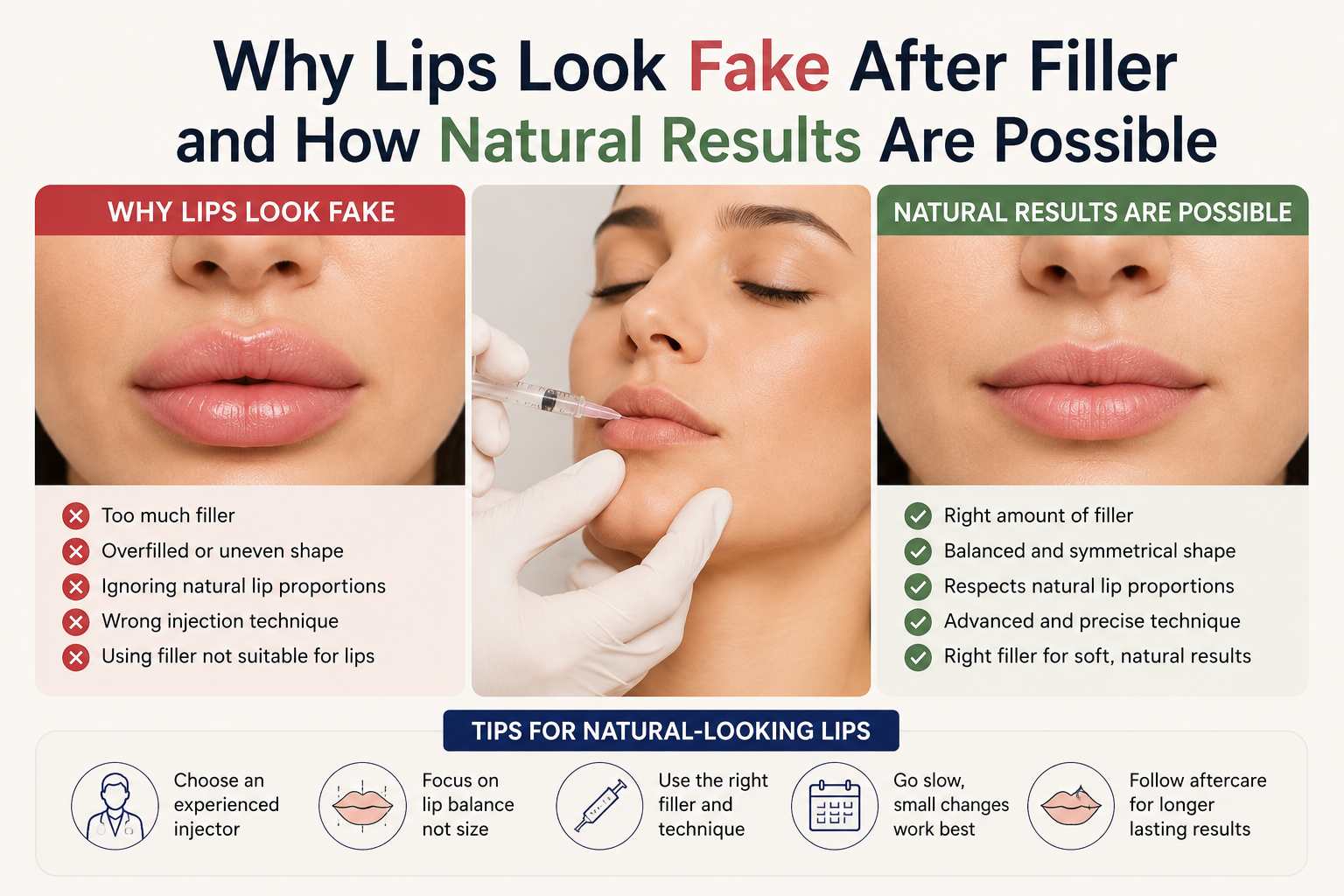
Why Lips Look Fake After Filler, And How A Natural Result Is Achieved
Lips look fake for four reasons: too much volume in one session, product placed above the natural border, a filler too firm for lip tissue, and upper and lower lip proportions ignored. Treating a small volume, respecting the vermilion border and reviewing at four weeks avoids all four.
When patients ask why lips look fake after filler, the answer is usually not filler itself but how the treatment has been planned and performed. A natural lip filler result should suit the existing lip shape, facial proportions and movement rather than simply making the lips as large as possible.
What Actually Makes A Lip Result Look Unnatural?
An unnatural lip filler result usually develops when volume, placement, product characteristics or proportion are not appropriate for the patient's natural anatomy.
1. Too Much Volume In One Session
Adding too much filler at once can make the lips look disproportionately large compared with the rest of the face. It can also produce excessive projection when viewed from the side.
The goal should not simply be to use an entire syringe. The appropriate amount depends on the starting lip volume, shape, symmetry and desired change.
For patients who want subtle enhancement rather than obvious augmentation, treatment may be better planned gradually. You can read more about this approach in the Natural Lip Filler in Surat guide.
2. Filler Placed Beyond The Natural Lip Border
The vermilion border defines where the coloured portion of the lip meets the surrounding skin.
When filler sits beyond this natural boundary, the lip can develop a ridge or shelf above the border. From the side, this may make the upper lip project unnaturally.
This should also be distinguished from temporary swelling immediately after treatment. The final result should not be judged during the first few days.
3. A Product That Is Too Firm For The Lip
Different fillers have different physical characteristics. A product that works well for structural support elsewhere in the face may not necessarily create the desired softness and movement in the lips.
Product selection should therefore reflect what the treatment is intended to achieve.
A patient seeking hydration and subtle softness, for example, may have different requirements from someone seeking a noticeable change in lip shape. The Hydration Lip Filler Treatment guide explains the hydration-focused approach in more detail.
4. Ignoring Upper-To-Lower Lip Proportion
Lip enhancement should consider both lips together.
Adding volume predominantly to the upper lip without considering the lower lip can make the result appear top-heavy or create excessive projection.
Natural proportions vary from person to person, so there is no single ratio that every patient should be given. The existing anatomy and overall facial proportions should guide treatment.
How Much Volume Is Too Much In A Single Session?
There is no universal amount of filler that produces natural lips for everyone.
This is why the question how much filler for natural lips cannot be answered with one fixed volume.
Someone with naturally thin lips who wants a very subtle change may require a different treatment plan from someone who already has good lip volume but wants improved border definition or symmetry.
More filler does not automatically produce a better result.
A conservative first treatment allows the lips to settle before deciding whether additional volume is actually necessary. Building the result gradually can also make it easier to preserve the patient's natural proportions.
The treatment plan should consider:
- Existing lip volume
- Upper and lower lip proportions
- Lip width
- Side-profile projection
- Existing asymmetry
- Previous filler
- Desired level of enhancement
- Natural movement while speaking and smiling
If the primary concern is shape rather than overall size, the Lip Reshaping Treatment in Surat guide provides more information about changing lip contours without focusing only on volume.
How Do Product Choice And Injection Depth Change The Look?
A natural result depends on more than the number of millilitres injected.
The characteristics of the filler and the layer in which it is placed influence how the lips look, feel and move.
Lip tissue is mobile. The lips move while smiling, speaking, eating and making expressions. Treatment therefore needs to account for both appearance at rest and movement.
Placement is equally important.
Filler placed inappropriately can create unwanted projection, visible irregularity or fullness outside the intended lip contour.
Injection depth and technique should be selected according to the patient's anatomy and the treatment objective rather than applying the same technique to every lip.
The objective may be to:
- Improve hydration.
- Define part of the lip border.
- Correct asymmetry.
- Add subtle volume.
- Improve lip shape.
- Support specific areas without enlarging the entire lip.
For fine lines around the upper lip rather than lip volume itself, Top Lip Line Filler Treatment addresses a different concern and should not be confused with simply adding more volume to the lips.
What Are The Visible Signs Of An Overfilled Lip Versus A Natural One?
Overfilled lips are not defined simply by being large. Naturally full lips can still look proportionate, while a smaller amount of poorly positioned filler can appear unnatural.
The result should therefore be assessed in relation to the patient's original anatomy and the rest of the face.
Natural Versus Overfilled Lip Filler
| Feature | Natural result | Overfilled result | How it may be corrected |
|---|---|---|---|
| Border definition | Clear but follows the natural vermilion border | Ridge or fullness extending beyond the natural border | Assess placement; inappropriate HA filler may need correction or dissolving |
| Upper-to-lower ratio | Balanced with the patient's natural anatomy | Upper lip may appear disproportionately dominant | Reassess proportions before further treatment |
| Profile projection | Lip projection remains balanced with the face | Excessive forward projection or shelf-like appearance | Avoid adding more filler; assess existing product |
| Movement on smiling | Lips remain mobile and expression looks natural | Lips may appear excessively bulky or distorted during movement | Review volume, placement and product |
| Texture | Smooth and appropriate for the lip | Visible or palpable irregularity may be present | Allow swelling to settle, then assess lumps or filler placement |
Temporary swelling can exaggerate lip size immediately after treatment, so a result that looks unusually large on day one is not automatically an unnatural lip filler result.
The settled appearance is more useful for assessing whether the volume and proportions are appropriate.
What Can Be Done If Your Lips Already Look Overfilled?
If your lips already look overfilled, the first step is to determine why.
Do not automatically add more filler in an attempt to correct the shape.
An assessment should consider whether the appearance is caused by:
- Temporary swelling
- Excessive filler volume
- Poorly distributed filler
- Product outside the intended border
- Migration
- Asymmetry
- An unsuitable product characteristic
- A proportion problem between the upper and lower lip
If treatment was performed recently, the lips may need time to settle before the final result can be judged.
If excess or poorly positioned hyaluronic acid filler remains after the appropriate review period, correction may include dissolving some or all of the filler before creating a new treatment plan.
The objective should be to identify the cause of the unnatural appearance rather than repeatedly adding product.
Conclusion
Understanding why lips look fake after filler starts with four main factors: excessive volume in one session, filler extending beyond the natural border, inappropriate product characteristics and poor upper-to-lower lip proportion.
A natural lip filler result should respect the patient's existing anatomy rather than follow a standard lip size or shape. Conservative treatment, appropriate filler selection, careful placement and reassessment after settling can help reduce the risk of an obviously treated appearance.
If the lips already appear overfilled, adding more filler is not automatically the answer. The cause should first be assessed so that swelling, excess volume, migration, placement and proportion problems can be distinguished and an appropriate correction plan considered.