Botox and Fillers With a Facelift: Can They Be Combined?
Written by Dr. Ashutosh A. Shah, M.B.B.S., M.S., M.Ch., D.N.B., Board Certified Plastic Surgeon, Elegance Clinic. In practice since 2004.
Medically reviewed by Dr. Ashutosh A. Shah
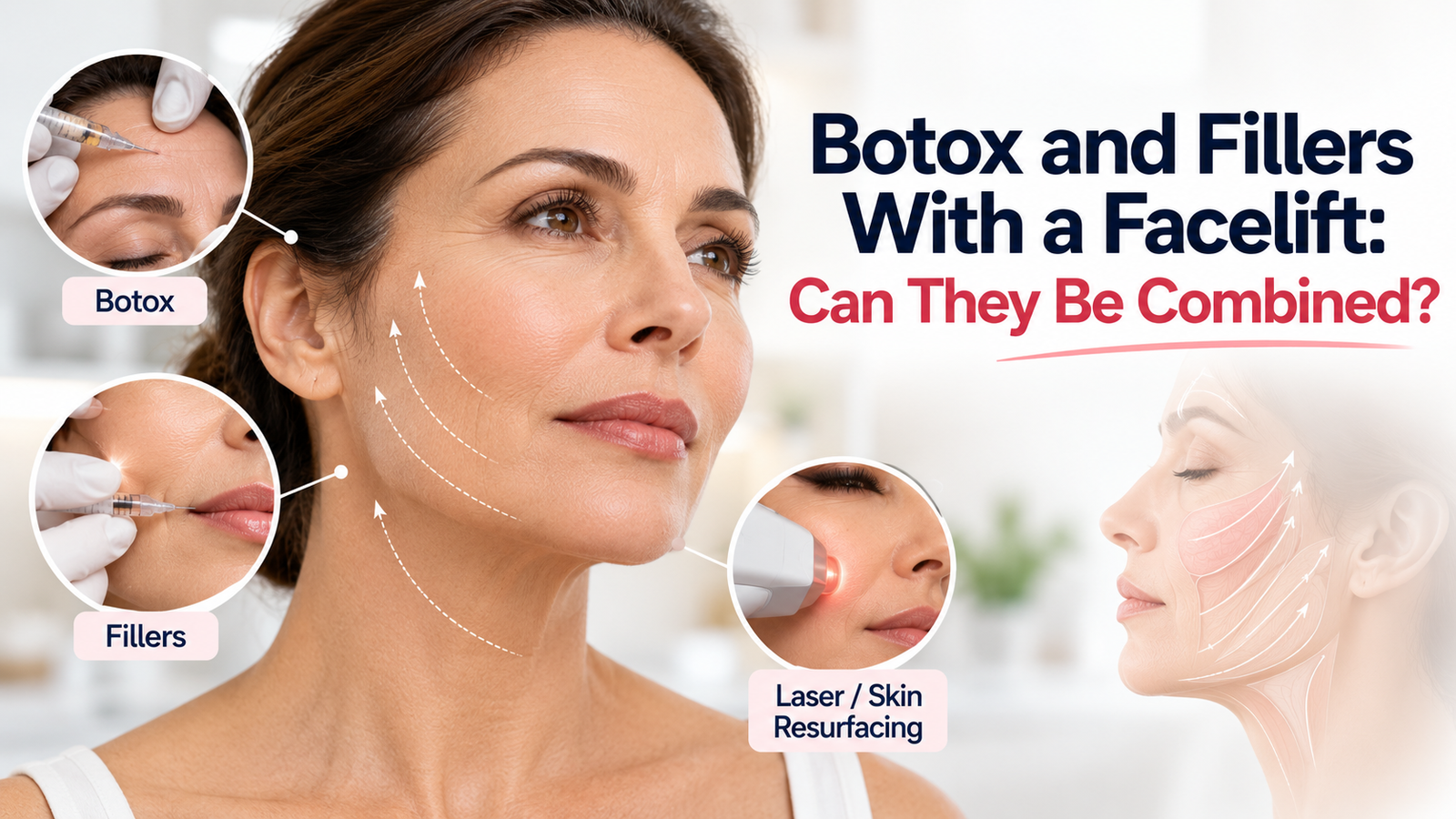
Yes. Botox and fillers with a facelift are often combined, because each treats a different problem. A facelift lifts sagging skin and tissue, filler restores lost volume, Botox softens expression lines and laser improves skin texture. They are usually timed in stages around the surgery rather than all on one day.
A facelift is powerful, but it does not do everything. It lifts what has dropped, yet it does not refill hollow cheeks, stop frown lines from forming or smooth sun-damaged skin. That is why many patients plan combining surgery and injectables, and sometimes laser, into one overall plan. This decision guide explains what each treatment fixes, who benefits from combining them, how the timing usually works, and when it is better to wait.
What does each treatment fix?
Each treatment works on a different layer of ageing. A facelift works on sagging, Botox on muscle movement, filler on volume, and laser or peels on the skin surface.
| Treatment | What it fixes | What it does not fix |
|---|---|---|
| Facelift (surgery) | Jowls, sagging cheeks and loose skin of the lower face and neck | Volume loss, expression lines, skin texture |
| Botox | Frown lines, forehead lines, crow's feet and neck bands caused by muscle movement | Sagging skin or lost volume |
| Dermal filler | Hollow cheeks, temples, lips, under-eye hollows and deep folds | Loose skin that hangs |
| Laser, peels or IPL | Fine lines, uneven pigment, sun damage and rough texture | Sagging or deep volume loss |
The American Society of Plastic Surgeons notes that fat transfer or fillers may be suggested to replace lost volume during facelift planning, that IPL, dermabrasion, peels or laser may be offered to improve skin quality, and that minimally invasive treatments can complement the results of surgery.
Our Botox treatments and Dermal filler treatments pages list the areas we treat.
Who benefits from combining surgery and injectables?
Patients who have more than one type of ageing at the same time benefit most. Few faces show sagging alone. Most also show some volume loss and some expression lines.
- Sagging plus hollow cheeks: a facelift lifts the jowls, and filler or fat restores the cheek fullness that lifting alone cannot bring back.
- Sagging plus strong frown or forehead lines: the facelift does not reach the upper face, so Botox keeps those lines soft.
- Sagging plus sun-damaged skin: laser or peels improve the skin surface that surgery leaves unchanged.
- Thin lips or a weak chin: small amounts of filler balance the lower face after it has been lifted.
Combining is common in practice. A small study in the Journal of Cosmetic Dermatology (Myers and colleagues, 2026) reviewed 20 facelift patients. All had used Botox-type injections before surgery and all resumed them afterwards, while most had also used filler before. The authors were clear that their sample was too small to confirm safety.
How are Botox, fillers and laser timed around a facelift?
When planning Botox and fillers with facelift surgery, they are usually done in stages, not on the day of surgery. The face needs time to heal and swelling must settle before injectables are placed, because swelling makes it hard to judge where filler is needed.
There is no single guideline that sets exact dates. The plan below reflects common clinic practice and is always adjusted to your healing.
| Stage | Botox | Filler | Laser or peels |
|---|---|---|---|
| Before surgery | Can continue as normal; the surgeon may ask you to pause a few weeks before | Avoid new filler in the lower face and cheeks in the weeks before surgery | Avoid strong peels or laser on the face in the weeks before surgery |
| Day of surgery | Sometimes given to the upper face if planned in advance | Fat transfer may be done during the facelift instead of filler | Not usually combined with the incisions |
| First weeks after | Wait until swelling and bruising settle | Wait | Wait until incisions have healed |
| A few months after | Resume regular sessions | Fine-tune volume once the face has settled | Start laser after facial surgery once the skin is fully healed and the surgeon clears it |
| Long term | Every 3 to 4 months as usual | Top up as needed | Maintenance as advised |
For reference, in the study above, the median gap between the last Botox session and the facelift was about 202 days and about 273 days for filler. After surgery, patients restarted Botox after a median of 177 days and filler after 300 days. These describe what one small group did, not a rule.
In our practice, Dr. Ashutosh Shah plans the injectable and skin treatment schedule at the same consultation as the surgery, so each step has a date and nothing is rushed. [Dr. Shah to confirm or reword.]
Is laser after facial surgery safe?
It can be, once the incisions have healed and the surgeon confirms the skin is ready. Laser or deep peels too soon after surgery can irritate healing skin and scars. Gentle skin care usually comes first, and stronger resurfacing is added later.
When should you not combine them?
Combining is not right for everyone, or not at the same time. A staged approach, or waiting, is safer in these situations:
- Healing problems or infection after surgery, until fully resolved
- A history of filler lumps, migration or reactions, which needs assessment before more filler is planned
- Large amounts of old filler in the face, which the surgeon may want to assess or dissolve before surgery
- Unrealistic expectations, such as hoping injectables will replace a needed facelift, or that surgery will remove every line
- Pregnancy or breastfeeding, when Botox and fillers are avoided
- Blood-thinning medicines that have not been reviewed by the prescribing doctor
Can fillers replace a facelift?
Only for mild sagging. Filler can lift and refill a face with early volume loss, but when skin and tissue hang below the jawline, filler cannot pull them back up and too much can make the face look heavy. That is the point where surgery, often with filler afterwards, gives a more natural result.
How is the decision made at Elegance Clinic?
The decision starts with examining which layers of your face have changed, then matching a treatment to each one. Botox and fillers with a facelift are planned together so the result looks balanced, not overdone.
- Assessment: sagging, volume, muscle movement and skin quality are checked separately, with photos at rest and in expression.
- Priority: the treatment that will make the biggest difference is planned first.
- Sequence: surgery, injectables and skin treatments are given dates that allow proper healing between them.
- Review: results are checked as swelling settles, and filler or Botox is adjusted in small steps.
If you are new to injectables, read what happens at a first-time Botox visit. For specific areas, see Jaw slimming Botox and Natural lip filler, and our Botox FAQs answer common safety questions.
Next step: bring a list of any Botox, filler or skin treatments you have had, with dates, to your consultation. To plan a combined approach, see our Clinic location or call +91 8320500350.
This page is for education and is not a substitute for examination. Botox, fillers and surgery must be planned and given by a qualified doctor. Combining facelift with fillers and skin treatments is described by the American Society of Plastic Surgeons; study figures are from Myers et al., Journal of Cosmetic Dermatology 2026. The timing table reflects this clinic's practice, not a published guideline. Results vary between individuals.