
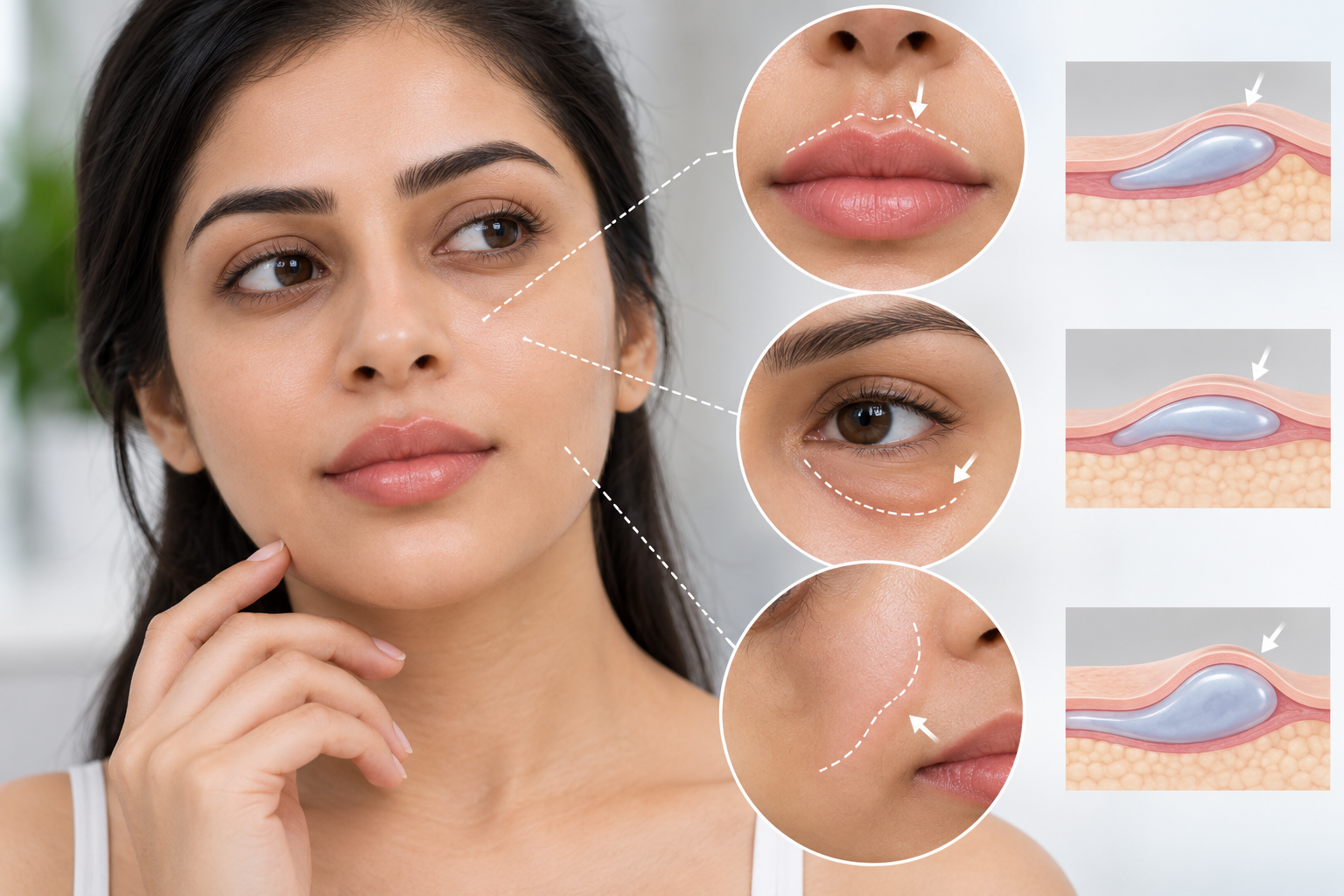
Filler Migration: The Signs That Product Has Moved and What Can Be Done
Migration shows as a soft shelf of product beyond the natural border: a ridge above the lip line, a puffy band under the eye, or fullness spreading past the cheek. Unlike swelling it does not settle within two weeks. Correction is usually dissolving and reinjecting with a smaller, better-placed volume. These filler migration signs can appear in different ways depending on the treatment area. Lip filler migration may create fullness above the natural lip border, while migrated filler around the under-eyes or cheeks can make the face look persistently puffy or less defined. The important point is that not every lump, swollen area or uneven contour means filler has migrated. Normal swelling, overfilling and product placement can sometimes create a similar appearance. A clinical assessment helps determine what has happened before any correction is attempted. Filler migration means that filler appears beyond the area where the intended correction was planned. The appearance varies according to the treatment area, previous filler, individual anatomy and the amount of product used. The lips are one of the most noticeable areas for migration. Typical filler migration signs around the lips can include: Someone concerned about whether filler will alter their natural lip shape can also read Will lips look unnatural after filler. Fullness above the lip does not automatically prove that the product has migrated. Too much filler in the lips can produce a similar appearance. Under-eye filler can be more difficult to assess because several problems can cause puffiness. Possible signs include: Fluid retention, existing eye bags, product characteristics and placement can all affect the appearance. Persistent under-eye swelling therefore needs assessment rather than automatically being labelled migration. Cheek filler is normally placed to create or restore a defined facial contour. Possible concerns include: These changes can sometimes contribute to what patients describe as a puffy filler face. There is rarely one single cause of filler migration. Technique, product selection, treatment volume, anatomy and previous filler can all contribute. Adding excessive volume can make a treated area look bulky and extend beyond its natural boundaries. This is particularly relevant in small areas such as the lips. When patients repeatedly receive additional filler without reassessing the existing volume, an overfilled appearance may gradually develop. Previous filler may remain for longer than a patient expects. Adding new product without considering what is already present can gradually change the shape and proportions of the treated area. This is why patients should tell their practitioner about previous filler treatments, even when they were performed elsewhere or some time ago. The depth and anatomical plane in which filler is placed matter. A practitioner needs to understand the anatomy of the treatment area and choose an injection approach appropriate for the desired result. Poor placement can create irregularities that may look like migration. Dermal fillers have different physical characteristics. A product appropriate for one facial area may not be ideal for another. Product selection should take into account the anatomical location, desired amount of projection or softness and individual tissue characteristics. Skin thickness, tissue structure, facial movement and natural proportions can influence how filler behaves. There is therefore no single volume or injection technique that is suitable for every face. Distinguishing migration from swelling is one of the most important parts of assessing suspected filler migration signs. Swelling commonly occurs after filler injections. During the early healing period, the treated area may look: This appearance can change considerably as swelling settles. Migration becomes more likely when fullness remains beyond the expected settling period and appears outside the intended anatomical boundary. A typical example is filler moved above lip line, producing a persistent shelf or ridge above the natural lip border rather than generalized temporary swelling. Overfilling is different again. Too much product can stretch or blur the natural contour without necessarily meaning that the filler has physically migrated. Because migration and overfilling can look similar, simply looking at a photograph may not be enough to distinguish between them. For patients considering treatment around the upper lip area, the Top lip line filler treatment page explains another specific filler application. This simple table can help you understand what different changes may indicate. It is not a substitute for clinical examination. The answer to how to fix migrated filler depends on what product was used, where it was placed and whether the problem is actually migration. If filler was injected recently, the first step may simply be allowing sufficient time for swelling to settle. Correcting an area too soon can result in treating temporary swelling rather than the final outcome. Trying to hide migration by adding more filler can sometimes make the area look heavier. If an area is already overfilled, additional volume may worsen the contour. If the migrated product is a suitable hyaluronic-acid filler, a trained clinician may consider hyaluronidase. Hyaluronidase is an enzyme used to break down hyaluronic-acid filler. Not every filler problem needs to be dissolved, and hyaluronidase does not dissolve every type of dermal filler. The practitioner should first consider: Depending on the situation, more than one assessment or correction session may be required. If filler is dissolved, immediately replacing the same amount may recreate the original problem. The area should be allowed to settle so its natural shape can be reassessed. When future filler is appropriate, a more conservative amount can be considered. The objective should be to restore proportion and definition rather than simply replace every millilitre that was dissolved. Patients interested in subtle lip enhancement can also read about Hydration lip filler treatment in Surat. Having previous migration does not automatically mean you can never have filler again. Future treatment should begin with reassessment rather than immediately adding more product. The practitioner should determine whether residual filler remains and whether it affects the planned treatment. More filler does not automatically produce a better result. Smaller volumes, carefully placed, may provide sufficient enhancement while preserving natural anatomical boundaries. Product selection should be based on the treatment area, tissue characteristics and desired result. Repeated top-ups should not be performed simply because a fixed amount of time has passed. The existing result should be reviewed first. A planned follow-up allows the practitioner to assess how the product has settled before deciding whether additional treatment is appropriate. For broader questions about injectable treatments and follow-up, see the Botox and filler FAQs. Migration may become noticeable after the initial treatment period, but early swelling can mimic it. For this reason, a new ridge, puffiness or asymmetry immediately after treatment should not automatically be called migration. The appearance should be assessed after the expected swelling has had time to settle unless there are symptoms requiring earlier medical review. Some changes that look like migration shortly after treatment may improve as swelling settles. Persistent product outside the intended area is different. Hyaluronic-acid fillers are gradually broken down over time, but the process can be slow and variable. If the appearance remains bothersome, a professional assessment can determine whether observation or correction is more appropriate. No. A firm lump does not automatically mean filler has migrated. Lumps can occur because of swelling, product distribution, placement, inflammatory reactions or other filler-related problems. A persistent, painful, enlarging or otherwise concerning lump should be examined rather than repeatedly massaged or treated at home. Migration is particularly noticeable around the lips because the lip border is clearly defined and the area is highly mobile. Repeated filler, excessive volume and inappropriate placement may contribute to an unnatural contour. However, concerns about filler position or persistent fullness can also occur in areas such as the under-eyes and cheeks. The appearance after correction varies. If an area has been repeatedly filled, patients may become accustomed to seeing additional volume. After dissolving, the natural anatomy can therefore initially appear smaller than expected. The purpose of correction is not necessarily to remove all volume permanently. Once the tissues settle, the area can be reassessed and, where appropriate, treated again conservatively. In many cases, previous migration does not automatically prevent future filler treatment. The cause of the previous problem should first be considered. Future treatment may involve a different volume, injection approach, product choice or treatment plan. The goal should be a controlled result that respects the natural anatomical boundaries rather than repeatedly adding volume. Most discussions about filler migration concern appearance rather than an emergency. However, certain symptoms after filler injections can indicate a more serious complication. Seek urgent medical assessment if you develop: These are not routine filler migration signs. Any visual change following facial filler treatment requires emergency medical assessment. Filler migration signs can include a persistent ridge above the lip border, a puffy band beneath the eyes or fullness extending beyond the intended cheek contour. Lip filler migration is particularly noticeable when product appears above the natural lip line. However, migration, swelling and overfilling can look similar. The first step should therefore be assessment rather than adding more filler or aggressively massaging the area. When appropriate, migrated hyaluronic-acid filler may be dissolved before the area is allowed to settle. If filler is used again, a smaller, better-placed volume may help achieve a more controlled result.What Does Filler Migration Actually Look Like in the Lips, Under-Eyes and Cheeks?
Lip Filler Migration
Under-Eye Filler Migration
Cheek Filler Migration
Which Techniques and Product Choices Make Migration More Likely?
Too Much Filler
Repeated Filler Sessions
Injection Technique
Product Choice
Individual Anatomy
How Is Migration Different From Ordinary Swelling or Overfilling?
Normal Swelling
Filler Migration
Overfilling
Filler Migration Self-Check
Sign You Can See
Likely Explanation
When to Review
Mild swelling immediately after filler
Expected post-injection swelling
Monitor according to aftercare advice
Mild early asymmetry
Swelling or bruising
Routine review if it persists
Persistent ridge above the upper lip
Possible lip filler migration or overfilling
Clinical review
Filler appears above the natural lip line
Possible migration or excess product
Clinical review
Persistent puffy band under the eye
Swelling, placement issue or possible migration
Clinical review
Cheeks look unusually broad or puffy
Possible overfilling or migration
Four-week review if otherwise well
Firm persistent lump
Several causes are possible; not automatically migration
Clinical assessment
Increasing pain or unusual skin colour
Possible complication rather than migration
Urgent review within 48 hours or sooner
Any new visual symptoms
Possible serious filler complication
Emergency medical assessment
What Are the Correction Options and How Long Does Correction Take?
Wait and Reassess
Avoid Adding More Filler
Dissolving Hyaluronic-Acid Filler
Let the Area Settle Before Refilling
Reinject With a Smaller, Better-Placed Volume
How Do You Plan Future Treatment So Migration Does Not Happen Again?
Review Existing Filler
Use Conservative Volumes
Choose the Product for the Area
Allow Adequate Time Between Treatments
Maintain Follow-Up
How Soon After Treatment Can Migration Appear?
Can Migrated Filler Settle Back on Its Own?
Does a Firm Lump Always Mean Migration?
Is Migration More Common in the Lips?
Will Correction Leave the Area Deflated?
Can I Still Have Filler in Future After a Migration?
When Should You Seek Urgent Medical Attention?
Key Takeaways