Non-Surgical Rhinoplasty: Which Nose Shapes Filler Can Correct, And Which It Cannot
Written by Dr. Ashutosh Shah, plastic surgeon, M.B.B.S., M.S., M.Ch., D.N.B. (Plastic Surgery), Board Certified Plastic Surgeon, Elegance Clinic.
Medically reviewed by Dr. Ashutosh A. Shah · Reg. no. G-26257 · Last reviewed 30 October 2026
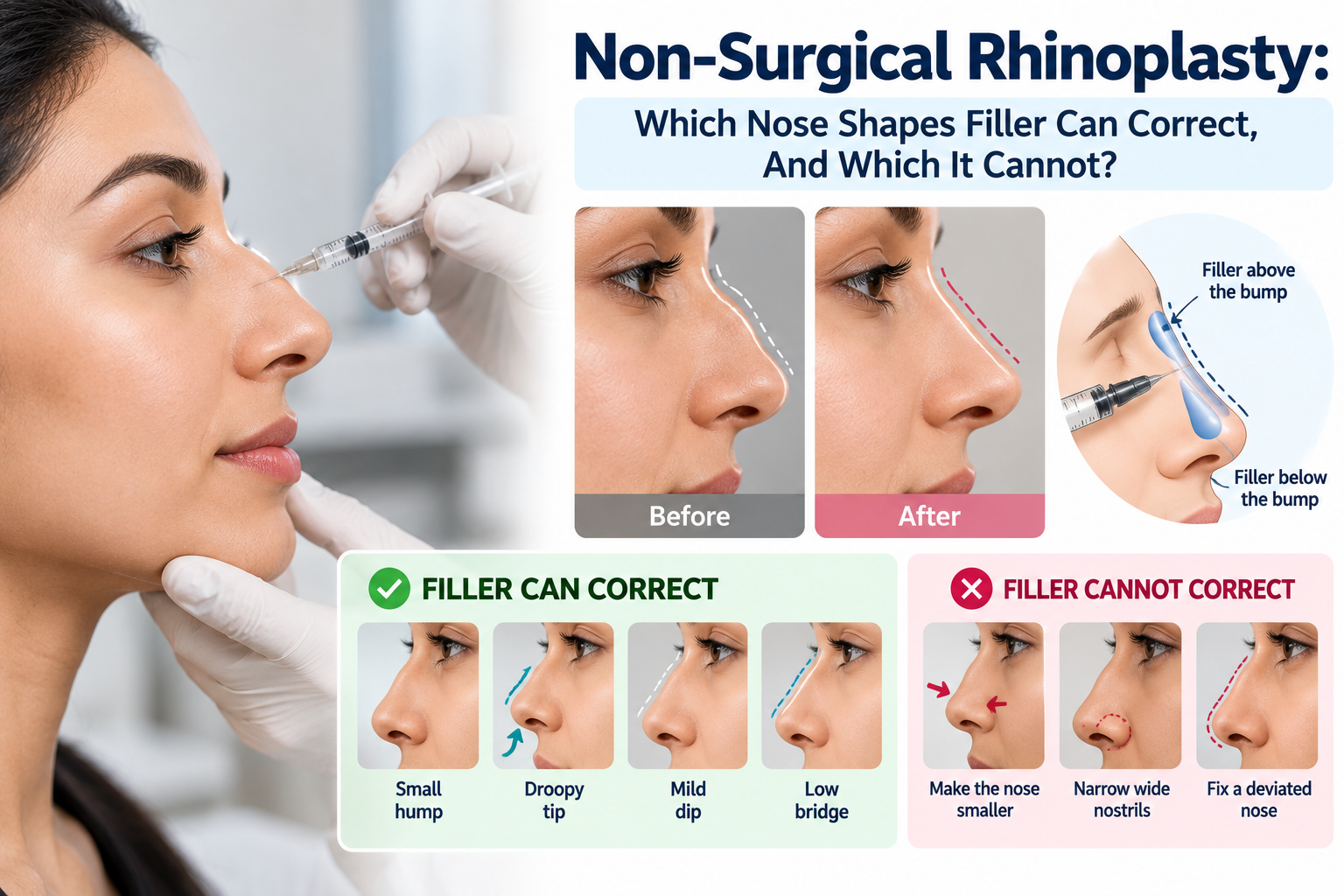
Non-surgical rhinoplasty uses small amounts of filler to camouflage a dorsal hump, lift a drooping tip or balance a mild dip, so the nose looks straighter in profile. It cannot make a nose smaller, narrow wide nostrils or fix breathing. Filler in the nose carries a real vascular risk, so it must be done by a trained doctor.
Can non-surgical rhinoplasty fix a hump on the nose? Often, yes, but not by removing it. Filler is placed above and below the bump so the line of the nose looks straight. That difference matters, because it explains both what liquid rhinoplasty does well and what it cannot do. This guide covers non surgical rhinoplasty for hump nose concerns and other shapes: who suits it, why the nose is a higher-risk area for filler, how long it lasts and when surgery is the better choice.
What can nose filler change and what can it not?
Nose filler can add volume to smooth and lift. It cannot take anything away. Every change it makes comes from adding a small amount of gel in the right place.
What filler can do
- Camouflage a dorsal hump: filling the dip above the bump makes the bridge look straight in profile.
- Lift a slightly droopy tip: a little support at the base can raise the tip angle.
- Fill a mild dip or scoop along the bridge.
- Raise a low, flat bridge between the eyes.
- Soften small irregularities, in carefully selected cases.
What filler cannot do
- Make the nose smaller or shorter.
- Narrow wide nostrils or a wide nasal base.
- Straighten a nose that is truly bent because of bone or cartilage.
- Fix breathing problems, such as a deviated septum.
- Remove a large hump; it can only hide a small one.
Because filler adds volume, a nose treated with filler is very slightly larger, even though it looks straighter. That is why nasal dorsum correction filler suits small corrections, not big changes.
Which nose shapes are good candidates?
Good candidates have a small hump, a mild dip or a slightly droopy tip, healthy thick skin over the bridge and no previous nose surgery. The table below shows how common concerns compare.
| Nose concern | Filler suitable? | Expected change | Surgery needed? |
|---|---|---|---|
| Dorsal hump | Yes, if small | Bridge looks straight in profile; nose very slightly fuller | For a large hump, or if you want the nose smaller |
| Droopy tip | Sometimes; Botox may also help | Small lift of the tip angle | If the tip is long, heavy or droops because of cartilage |
| Wide nose | No | Filler cannot narrow the nose or nostrils | Yes, surgery is the only way to narrow it |
| Deviated nose | Only for a very mild, cosmetic tilt | Can make a slight tilt look straighter | Yes, for a true bend or any breathing problem |
| Post-surgery irregularity | Only after a plastic surgeon's assessment | May smooth a small dent or step | Often; scarred skin carries a higher filler risk |
For a tip that drops when you smile, a small muscle can be relaxed with Botox instead. See Botox for a downturned nasal tip and Nose tip correction.
Filler or surgery for a crooked nose?
Surgery, in most cases. A truly crooked nose is caused by bent bone, cartilage or septum, and filler cannot move these. Filler can only make a very mild tilt look straighter by building up one side. If the nose is crooked after an injury, or breathing is affected, see a plastic surgeon about rhinoplasty.
Why is the nose a high-risk area for filler?
Because the blood vessels of the nose connect to the vessels that supply the eye. If filler enters or presses on one of these vessels, it can block blood flow to the skin or, rarely, to the eye. A 2015 review of the world literature by Beleznay and colleagues found the nasal region was the second most frequently reported site for filler-related vision loss, after the area between the eyebrows.
The Australian Society of Plastic Surgeons, summarising that review, notes almost 100 reported cases worldwide. Vision loss is rare, but the risk is real, and that is why is liquid rhinoplasty safe is the right question to ask.
- Who injects matters: a trained doctor who knows nasal anatomy and can act at once if blood flow is affected.
- Hyaluronic acid filler only, so it can be dissolved in an emergency.
- Small amounts, placed slowly in safer deep planes.
- Warning signs to report at once: blanching or dusky skin, severe pain, or any change in vision.
Our rule: a nose that has had previous surgery, or has thin skin over the bridge, is high risk. It is assessed by a plastic surgeon before any filler is considered, and in many such cases filler is not advised.
Is liquid rhinoplasty safe?
It can be, when a trained doctor uses hyaluronic acid filler in small amounts on a suitable nose. It is not risk-free. The nose has a higher rate of serious vascular complications than many other face areas, so careful patient selection and an emergency plan matter more here than almost anywhere else.
How long does a liquid rhinoplasty last?
Often around a year, sometimes longer, because the nose moves very little and hyaluronic acid breaks down slowly there. The result is visible straight away, with some swelling for a few days.
- Immediately: the new profile is visible.
- First few days: mild swelling and tenderness settle.
- About 2 weeks: a review to check shape and symmetry.
- Over the following months: the filler slowly softens; a small top-up keeps the shape.
When is surgical rhinoplasty the better choice?
When you want the nose smaller, narrower or truly straight, or when breathing is a problem. Surgery can remove a hump, reshape the tip cartilage, narrow the bones and correct the septum, none of which filler can do.
- A large hump that you want removed, not hidden.
- A wide nose or wide nostrils.
- A crooked nose from bone or cartilage.
- Breathing difficulty or a deviated septum.
- A long or heavy tip.
- Previous nose surgery with significant irregularity.
For a Gujarati explainer on nose correction without surgery, see Nose correction bina surgery.
Considering a non surgical nose job in vesu? How the assessment works
The first step is an assessment, not an injection. Dr. Ashutosh Shah, plastic surgeon, checks your profile, skin thickness over the bridge, any previous surgery and your breathing, then tells you honestly whether filler, Botox, surgery or nothing is the right answer. In our clinic, a good number of people who come for nose filler are better suited to surgery or to leaving the nose as it is.
- Profile photos and a discussion of what bothers you.
- Skin and surgical history check, using the rule above.
- If suitable, hyaluronic acid filler in small amounts, with a dissolving plan ready.
- Review at about 2 weeks.
Next step: non surgical rhinoplasty for hump nose concerns works best on the right nose, chosen carefully. Book a consultation to find out whether filler, Botox or surgery suits your nose.
This page is for education and is not a substitute for medical advice. After any nose filler, sudden pain, skin colour change or any change in vision is an emergency: contact your doctor and seek urgent care at once.